If you have seen a horned, fierce-looking Japanese mask online, in a tattoo design, anime, costume, or artwork, you may be wondering about the oni mask meaning.
An oni mask represents an oni (鬼), a supernatural figure from Japanese folklore traditionally associated with fear, danger, punishment, disorder, and overwhelming strength.
However, calling an oni simply a “Japanese demon” can be misleading because its meaning changes with context.
An oni can also be connected with protection and the driving away of misfortune, particularly in traditions such as Setsubun.
Modern tattoos, fashion, gaming, and social media may use the image more freely to express power, anger, resilience, intimidation, or a darker aesthetic.
Quick Answer
An oni mask represents a horned supernatural being from Japanese folklore. Its common associations include danger, strength, fear, punishment, anger, and protection. In modern tattoos, art, costumes, and social media, an oni mask may symbolize confronting fear or embracing a powerful, intimidating identity. Its exact meaning depends on context.
What Does Oni Mask Mean in Text?
An oni mask is not normally a texting abbreviation or slang expression. If someone types “oni mask,” posts an oni mask emoji-like image, or sends a picture of one, they are generally referring to the Japanese folkloric figure or its visual symbolism.
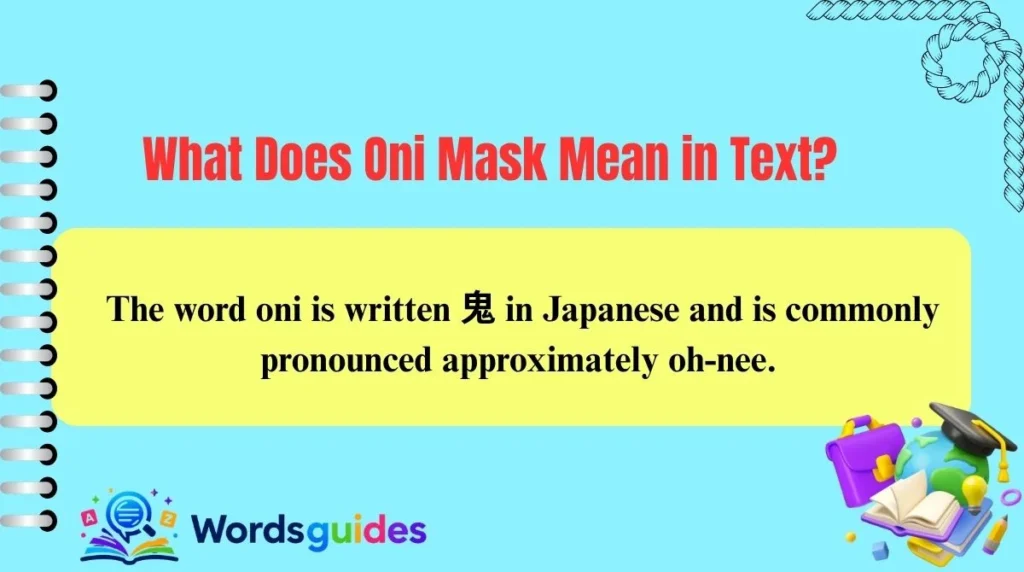
The word oni is written 鬼 in Japanese and is commonly pronounced approximately oh-nee. English translations often use words such as “demon” or “ogre,” although neither translation captures every meaning associated with the Japanese term.
Simple meaning
An oni mask is a representation of an oni, usually shown with:
- Horns
- Sharp teeth or fangs
- Wild hair
- A fierce expression
- Strong, exaggerated facial features
- Red, blue, black, green, or other colors
The emotional message is usually fierce, intimidating, powerful, supernatural, or protective, rather than cute or gentle.
For example:
Friend 1: “What does this mask symbolize?”
Friend 2: “It’s an oni mask. It usually has a fierce or protective meaning.”
The surrounding conversation matters. Someone posting the mask after talking about anger may be emphasizing rage or intensity, while someone using it with a Japanese festival photo may simply be referring to traditional oni imagery.
Origin and Background of the Oni Mask
The oni is a long-established figure in Japanese folklore and religious culture. The character 鬼 has connections with older East Asian concepts of supernatural beings and spirits, while the Japanese oni developed into a broad folkloric category with different roles across stories and traditions.
Oni are often portrayed as frightening, powerful creatures. In some contexts they appear as destructive or punitive beings; in others, frightening oni imagery is used to represent or drive away harmful forces.
One of the best-known associations is Setsubun, a Japanese seasonal custom in which people traditionally throw roasted soybeans while saying a phrase meaning roughly “oni out, good fortune in.” A person wearing an oni mask may play the role of the unwanted oni during the ritual.
This is why the meaning cannot be reduced to simply “evil.” The same frightening image can function as a symbol of danger, an antagonist, a ritual figure, or protection.
How Oni Masks Are Used in Conversations
Because “oni mask” is a noun rather than a standard texting abbreviation, people generally use it literally or symbolically.
Casual use
A: “What’s that mask in your profile picture?”
B: “An oni mask. I just like Japanese folklore.”
Here, there is no hidden slang meaning.
Humorous use
A: “You should’ve seen Dad when we woke him up.”
B: “😂 Full oni mask mode?”
The speaker is using the frightening appearance metaphorically to describe an angry or intimidating expression.
Talking about a tattoo
A: “I’m thinking about getting an oni mask tattoo.”
B: “Nice. Are you going for the traditional Japanese style?”
In tattoo culture, the image can carry associations of strength, protection, fear, punishment, inner conflict, or confronting darker emotions.
Gaming, anime, or fandom use
A: “That character has an oni mask.”
B: “Yeah, it makes the character look seriously intimidating.”
In these contexts, the image may simply identify a character or aesthetic. Fictional works can also create their own interpretations of oni.
What Does Oni Mask Mean on Different Platforms?
The phrase does not have a different standard definition on major social platforms. Its interpretation usually comes from the surrounding post, image, caption, or conversation.
| Platform | Likely meaning |
|---|---|
| Usually a reference to an oni image, mask, costume, joke, or cultural topic | |
| Snapchat | May be used for a dramatic, scary, humorous, or costume-related visual |
| Commonly connected with tattoos, Japanese-inspired art, fashion, photography, or aesthetics | |
| TikTok | May appear in cosplay, cultural content, anime, storytelling, or trend-based videos |
| Often used in posts about Japanese culture, festivals, artwork, costumes, or tattoos | |
| Discord | May refer to gaming, anime, avatars, character designs, or a user’s profile image |
| Dating apps | Usually functions as an interest, aesthetic, tattoo reference, or profile-image choice rather than a secret dating code |
The important point is that “oni mask” does not become a separate slang term merely because it appears on one of these platforms.
What Does Oni Mask Mean From a Girl or Guy?
There is no fixed meaning based on whether a girl or guy sends or uses an oni mask.
The person’s gender does not determine what the image means. Instead, look at:
- What you were discussing
- Whether the person uses the mask as a profile picture or sends it directly
- The caption
- Emojis
- Punctuation
- Your relationship with the person
- Whether they are discussing tattoos, anime, Japanese culture, or costumes
For example, sending an oni image with “😂” could be a joke about looking angry. Sending one alongside “I want this tattoo” is more likely to express an artistic preference.
Even in a romantic conversation, an oni mask does not automatically have a sexual or romantic meaning. Context should always come before assumptions.
Other Possible Meanings of Oni Mask
The following are genuine contextual interpretations rather than separate texting definitions.
| Meaning | Context | Example |
|---|---|---|
| Japanese supernatural figure | Folklore and culture | “The mask represents an oni.” |
| Fear or danger | Artwork or storytelling | “The oni gives the scene a threatening feeling.” |
| Strength or intimidation | Modern fashion, gaming, or design | “That oni mask makes the character look powerful.” |
| Protection or warding off misfortune | Ritual and traditional contexts | “The oni is being driven away during Setsubun.” |
| Inner conflict or darker emotions | Tattoos and modern symbolism | “He chose an oni tattoo to represent overcoming his anger.” |
| Costume or character | Festivals, cosplay, photography | “She wore an oni mask for the festival.” |
The most common meaning is the literal one: a mask depicting an oni. Any deeper symbolism depends on the setting.
How to Respond to “Oni Mask”
Your response should depend on why the person sent it.
If you’re confused
“What does the oni mask mean here?”
If they are talking about Japanese culture
“Oh, is that an oni from Japanese folklore?”
If they sent it as a joke
“😂 Okay, that looks terrifying.”
If they are showing a tattoo idea
“That’s a cool design. What meaning do you want it to have?”
If you like the image
“That looks awesome. The horns and expression are intense.”
If you want to keep the conversation going
“Is there a particular reason you chose an oni mask?”
If you’re unsure whether there is a hidden meaning
“I’m not sure how you mean that—what are you referring to?”
That last response is particularly useful because an image alone rarely provides enough information to determine someone’s intended message.
Similar Terms and Their Differences
| Term | Meaning | Key Difference |
|---|---|---|
| Oni | Supernatural being in Japanese folklore | Refers to the figure itself, not necessarily a mask |
| Oni mask | Mask representing an oni | Refers specifically to the visual mask |
| Hannya | A specific Noh mask associated with a woman transformed by intense jealousy or resentment | Often confused with oni, but it represents a different figure and tradition |
| Yokai | Broad category of supernatural beings in Japanese folklore | Oni are a more specific type of supernatural figure |
| Tengu | Another supernatural being in Japanese folklore | Usually associated with mountain traditions and distinctive facial features |
An oni mask and Hannya mask are not interchangeable terms. Both can have horns and frightening expressions, but they represent different figures and traditions.
Common Misunderstandings About Oni Masks
“Oni” always means “devil”
Not exactly. “Demon,” “devil,” and “ogre” are useful English approximations, but oni has a broader cultural history. The meaning changes across folklore, religion, festivals, art, and modern entertainment.
Every oni mask has one fixed symbolism
It does not. A festival mask, tattoo, theatrical mask, costume, and decorative object can carry different meanings.
Red and blue always mean exactly the same thing
Color symbolism exists in some traditions and modern interpretations, but it should not be treated as a universal code for every oni mask. Some sources associate different colors with Buddhist concepts, while contemporary designs may simply use color for visual effect.
An oni mask is the same as a Hannya mask
This is a common mistake. They are different figures.
Sending an oni image has a secret texting definition
There is no widely established texting slang meaning for “oni mask.” If someone sends the phrase or image in a chat, the surrounding context is much more important than the words themselves.
Is an Oni Mask Appropriate or Safe to Use?
An oni mask is generally not an offensive or dangerous texting expression. It is a cultural and artistic reference that appears in traditional celebrations, folklore, tattoos, cosplay, entertainment, and modern design.
However, context and cultural respect matter. An oni image used in a discussion of Japanese folklore is different from using it carelessly to mock Japanese people or culture.
It is also worth remembering that an oni mask can look aggressive without communicating an actual threat. If someone sends an oni image while discussing violence, threats, or frightening behavior, respond to the surrounding message rather than assuming the mask itself carries a threatening meaning.
In a workplace conversation, the phrase is usually harmless when used to discuss a cultural image, design, costume, or character. Still, an intimidating image may be inappropriate if it conflicts with the professional setting.
Examples of Oni Mask in Text
- “I keep seeing this oni mask design on Instagram. What does it mean?”
- “That oni mask tattoo looks incredible.”
- “😂 Why does your new avatar look like an oni?”
- “Is an oni mask related to Japanese mythology?”
- “I’m wearing an oni mask for the cosplay event this weekend.”
- “My little brother put on an oni mask and scared everyone in the house.”
- “She chose an oni mask because she wanted something that represented strength.”
- “Wait, is that an oni mask or a Hannya mask?”
- “The character’s oni mask makes him look much more intimidating.”
- “I saw people wearing oni masks during a video about Setsubun.”
- “That mask looks scary, but apparently oni imagery can also be connected with protection.”
- “What made you choose an oni mask for your profile picture?”
Frequently Asked Questions
Is an oni mask good or bad?
An oni mask is not automatically good or bad. Oni are often portrayed as frightening or destructive, but oni imagery can also be associated with protection and the removal of misfortune. Modern users may choose the design simply because they like its appearance or because it represents strength. Context determines the intended meaning.
What does an oni mask symbolize?
An oni mask can symbolize fear, danger, strength, punishment, anger, protection, or confronting destructive forces. In modern tattoos and artwork, it may also represent resilience or inner conflict. There is no single universal interpretation, so the design’s setting and the creator’s intention matter.
Is an oni mask the same as a Hannya mask?
No. An oni mask represents an oni, a supernatural figure from Japanese folklore. A Hannya is a particular Noh mask associated with a female figure transformed by intense jealousy or resentment. Their horns and frightening expressions can make them look similar, but they have different identities and traditions.
What does oni mean in Japanese?
Oni (鬼) is a Japanese word commonly translated into English as “demon,” “ogre,” or “monster.” These translations are approximate. In Japanese culture and folklore, oni can have a wider range of associations than the English word “demon” suggests.
Does an oni mask have a meaning in texting?
Not as a standardized slang term. If someone writes “oni mask” or sends an oni mask image, they are usually referring to the cultural figure, a tattoo, costume, character, artwork, or aesthetic. Any emotional or humorous meaning comes from the surrounding conversation.
What does an oni mask tattoo mean?
An oni mask tattoo can represent strength, protection, danger, punishment, anger, inner conflict, or confronting fear. However, tattoo symbolism is personal, so the same design can mean different things to different people. The surrounding imagery, color, expression, and the wearer’s explanation can provide additional clues.
Conclusion
The oni mask meaning is broader than simply “Japanese demon.” It represents the fearsome oni of Japanese folklore and can suggest danger, strength, punishment, anger, protection, or the confrontation of darker forces.
In texting and social media, “oni mask” is not a standard slang expression, so context is essential. A profile picture, tattoo, meme, cosplay image, and traditional festival mask may all communicate something different.
When someone sends you an oni mask, consider the conversation, caption, emojis, and relationship before assigning a deeper meaning.

I am Lily Anderson, an English language writer passionate about explaining word meanings, vocabulary, grammar, pronunciation, and language usage through clear, accurate, and easy-to-understand educational content for learners worldwide.