Understanding syllables meaning is essential for reading, speaking, spelling, and improving pronunciation.
A syllable is a single unit of sound in a word that usually contains one vowel sound.
People often search for “syllables meaning” when learning English, helping children read, studying phonics, writing poetry, or improving pronunciation.
Whether you’re a student, teacher, parent, language learner, or simply curious about English, knowing how syllables work makes it easier to pronounce unfamiliar words, divide words correctly, and communicate more clearly.
Syllables are also important in poetry, songwriting, dictionaries, speech therapy, and language education.
In this guide, you’ll learn the complete syllables meaning, how syllables are used, different types of syllables, practical examples, common mistakes, and answers to frequently asked questions.
Quick Answer
| Topic | Information |
|---|---|
| Meaning | A syllable is a unit of pronunciation containing one vowel sound. |
| Full Form | None (Syllable is not an abbreviation.) |
| Pronunciation | SIL-uh-buhl (/ˈsɪl.ə.bəl/) |
| Category | Linguistics / English Grammar / Phonetics |
| Purpose | Helps with pronunciation, reading, spelling, and word division |
| Common Audience | Students, teachers, English learners, writers, poets |
| Common Use | Counting sounds in words and improving pronunciation |
| Reply Needed | No |
What Does Syllables Meaning Mean?
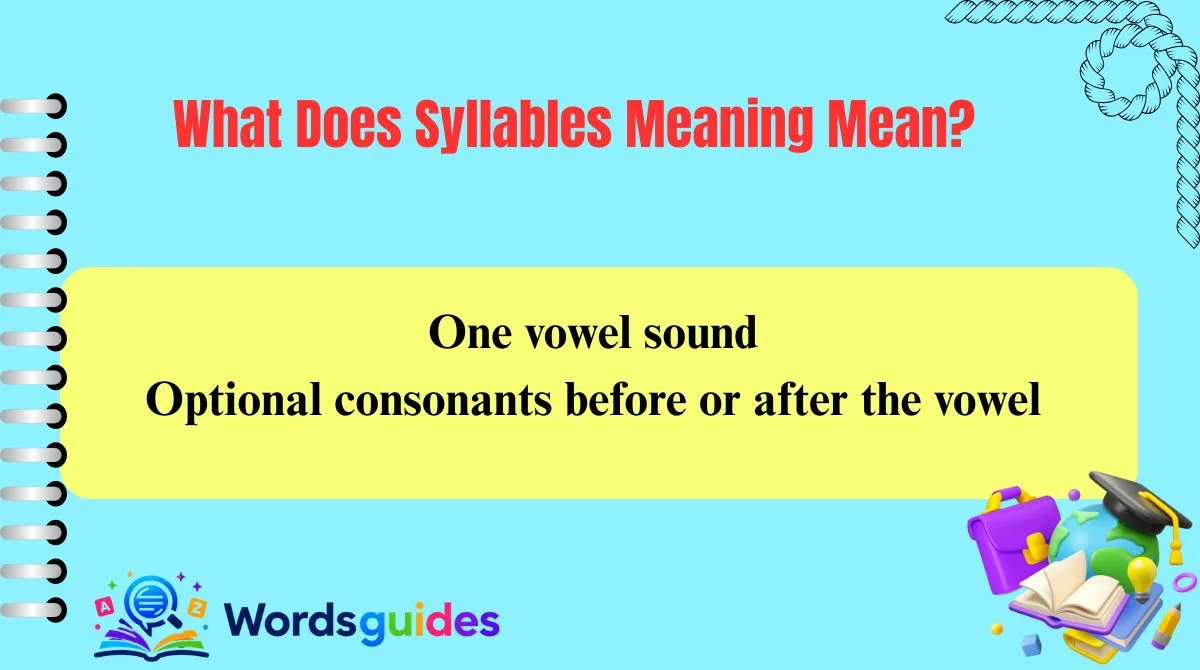
The syllables meaning is simple: a syllable is a single beat or sound unit within a word. Every spoken word is made up of one or more syllables.
A syllable usually contains:
- One vowel sound
- Optional consonants before or after the vowel
For example:
| Word | Number of Syllables |
| Cat | 1 |
| Apple | 2 |
| Banana | 3 |
| Elephant | 3 |
| University | 5 |
When speaking these words aloud, you can hear separate beats.
For example:
- Banana
- Ba
- Na
- Na
Each beat represents one syllable.
Simple Definition
A syllable is one spoken sound unit that forms part of a word.
Think of syllables as the rhythm of speech.
Full Form
The word syllable does not have a full form.
It is a complete linguistic term rather than an acronym or abbreviation.
How Many Syllables Can a Word Have?
Words can contain one syllable or several syllables, depending on how they are pronounced. A one-syllable word such as “book” has one sound unit, while “happy” has two: hap-py. Longer words can contain many syllables, such as “communication,” which is commonly pronounced with five syllables.
The number of syllables is based on spoken sounds rather than the number of letters. This is why spelling can sometimes be misleading. Listening to the word and saying it naturally is often the easiest way to identify its syllables. Accent and pronunciation can also affect syllable count in some words.
Why Are Syllables Important for Pronunciation?
Syllables help speakers break longer or unfamiliar words into smaller, easier sound units. Instead of trying to pronounce a long word all at once, learners can identify each syllable and practice the word step by step. This can make difficult vocabulary easier to read and say correctly.
Syllables also connect closely with word stress. In many English words, one syllable receives more emphasis than the others. Learning which syllable is stressed can make speech sound more natural and easier to understand. For students and English learners, practicing syllables can therefore improve both pronunciation and speaking confidence.
Origin and Background
The word syllable comes from the Latin word syllaba, which itself was borrowed from the Greek word syllabē, meaning “that which is held together.”
For thousands of years, syllables have been used to study:
- Reading
- Writing
- Poetry
- Public speaking
- Language learning
- Music
Modern schools teach syllables because they help learners:
- Decode unfamiliar words
- Improve pronunciation
- Develop reading fluency
- Understand spelling patterns
Today, syllables remain one of the foundations of phonics and literacy education.
How People Use It
People use the concept of syllables in many everyday situations.
In Schools
Teachers ask students to:
- Count syllables
- Divide words into syllables
- Read multisyllabic words
- Improve pronunciation
Example:
“How many syllables are in ‘computer’?”
Answer:
Com • pu • ter (3 syllables)
While Learning English
English learners use syllables to:
- Speak naturally
- Reduce pronunciation mistakes
- Learn word stress
- Read longer words confidently
In Poetry
Poets count syllables to create rhythm.
Example:
A haiku traditionally contains:
- 5 syllables
- 7 syllables
- 5 syllables
In Music
Songwriters divide lyrics into syllables so they fit the melody naturally.
In Dictionaries
Many dictionaries separate words into syllables to help with pronunciation.
Example:
Com·pu·ter
Types of Syllables
English has several common syllable types.
1. Closed Syllable
Ends with a consonant.
Examples:
- Cat
- Bed
- Fish
- Jump
2. Open Syllable
Ends with a vowel.
Examples:
- Go
- Me
- No
- She
3. Silent E Syllable
Ends with a silent “e.”
Examples:
- Cake
- Home
- Smile
4. Vowel Team Syllable
Contains two vowels making one sound.
Examples:
- Rain
- Boat
- Team
5. R-Controlled Syllable
Contains a vowel followed by “r.”
Examples:
- Bird
- Farm
- Corn
6. Consonant-le Syllable
Ends with “-le.”
Examples:
- Table
- Little
- Candle
How to Count Syllables
One simple method is to clap once for each vowel sound.
Example:
| Word | Syllables |
| Dog | 1 |
| Tiger | 2 |
| Banana | 3 |
| Chocolate | 3 |
| Education | 4 |
Remember that syllables are based on sounds, not simply the number of written vowels.
Meaning on Different Learning Platforms
Classroom
Teachers use syllables to teach reading, spelling, and pronunciation.
Online Learning Apps
Educational apps include syllable exercises to improve literacy and phonics skills.
Dictionaries
Many dictionaries divide words into syllables to show pronunciation and stress.
Speech Therapy
Speech-language pathologists use syllables to help individuals improve speech clarity and language development.
Poetry and Creative Writing
Writers count syllables to create rhythm and maintain poetic forms.
Real Conversation Examples
Example 1
Student: How many syllables does “apple” have?
Teacher: Two. Ap • ple.
Explanation: The word is divided into two spoken sound units.
Example 2
Parent: Clap the syllables in “banana.”
Child: Ba • na • na!
Explanation: Clapping helps children hear each syllable.
Example 3
Student: Is “dog” one syllable?
Teacher: Yes.
Explanation: “Dog” contains one vowel sound.
Example 4
Friend: Why do dictionaries use dots?
Friend: They separate syllables.
Explanation: The dots indicate where one syllable ends and the next begins.
Example 5
Teacher: Count the syllables in “computer.”
Student: Com • pu • ter.
Explanation: The word has three syllables.
Example 6
Poet: This line needs one fewer syllable.
Editor: Remove an extra word.
Explanation: Syllable count affects poetic rhythm.
Example 7
Singer: The lyrics don’t fit.
Producer: Split the words by syllables.
Explanation: Matching syllables to musical beats improves flow.
Example 8
English Learner: I can’t pronounce this word.
Tutor: Break it into syllables first.
Explanation: Dividing long words makes pronunciation easier.
Example 9
Teacher: What’s the first syllable in “holiday”?
Student: Hol.
Explanation: Identifying syllables helps with reading and spelling.
Example 10
Student: Are letters and syllables the same?
Teacher: No. A word may have many letters but only one syllable.
Explanation: Syllables depend on sounds, not letter count.
When Should You Use It?
Understanding syllables is useful when you want to:
- Improve pronunciation
- Learn English
- Teach reading
- Write poetry
- Sing songs
- Spell difficult words
- Understand dictionaries
- Study phonics
- Practice public speaking
Knowing the syllables meaning also helps with word stress, which is important for natural English speech.
When Should You Avoid Using It?
While the concept of syllables is valuable, avoid relying solely on written letters to count them.
Some words contain silent letters or unusual pronunciation patterns.
For example:
- Fire
- Every
- Chocolate
Depending on accent or dialect, speakers may pronounce these words with a different number of syllables.
If you’re unsure, listen to a reliable pronunciation rather than guessing from spelling.
Is It Rude, Offensive, or Flirty?
No.
The word syllable is a neutral educational term.
It is commonly used in:
- Schools
- Universities
- Dictionaries
- Language classes
- Speech therapy
- Linguistics
- Writing workshops
It has no rude, offensive, romantic, or slang meaning.
Other Meanings (If Any)
The primary and overwhelmingly common meaning of syllable relates to language and pronunciation.
Outside linguistics, the word is rarely used with a different meaning. Any figurative uses (such as “not a syllable was spoken”) still refer to spoken language rather than a new definition.
Similar Terms and Related Language Concepts
| Term | Meaning | Usage | Tone |
| Syllable | Unit of spoken sound | Pronunciation | Neutral |
| Phoneme | Smallest speech sound | Linguistics | Technical |
| Morpheme | Smallest unit of meaning | Grammar | Educational |
| Accent | Way words are pronounced | Speech | Neutral |
| Stress | Emphasis on a syllable | Pronunciation | Neutral |
| Phonics | Teaching reading through sounds | Education | Neutral |
| Pronunciation | How words are spoken | Language learning | Neutral |
| Rhythm | Pattern of stressed and unstressed syllables | Poetry and speech | Neutral |
Common Mistakes
Many learners misunderstand syllables meaning. Here are some frequent errors:
Mistake 1: Counting Letters Instead of Sounds
Incorrect approach:
- Counting every vowel letter.
Correct approach:
- Count vowel sounds, not letters.
Mistake 2: Assuming Long Words Always Have Many Syllables
Some long words have fewer syllables than expected because several letters combine into one sound.
Mistake 3: Ignoring Word Stress
Syllables and stress are related but not the same.
For example:
- PREsent (noun)
- preSENT (verb)
The syllable count stays the same, but the stressed syllable changes.
Mistake 4: Believing Every Vowel Forms a New Syllable
Two or more vowels can work together to create one vowel sound, as in boat or team.
Mistake 5: Forgetting Regional Differences
Some words are pronounced differently in various English accents, which can slightly affect how speakers count syllables.
FAQs
What is the simple meaning of a syllable?
A syllable is one spoken sound unit in a word that usually contains one vowel sound.
How do I count syllables?
Say the word naturally and count each separate beat or vowel sound.
Can a word have only one syllable?
Yes. Words like “cat,” “book,” and “sun” each have one syllable.
Why are syllables important?
They help with pronunciation, reading, spelling, poetry, and speaking clearly.
Is every vowel a separate syllable?
No. Multiple vowels can combine to make a single vowel sound.
What is the difference between a syllable and a phoneme?
A syllable is a larger sound unit, while a phoneme is the smallest individual speech sound.
Do all languages use syllables?
Yes. Although languages organize sounds differently, syllables are a fundamental feature of spoken language across the world.
Can pronunciation change the number of syllables?
Sometimes. Regional accents and fast speech may reduce or blend syllables in certain words.
Is a syllable the same as a beat in a word?
In many teaching methods, yes. Each syllable often corresponds to one rhythmic beat when spoken.
Why do dictionaries divide words into syllables?
They do this to help readers understand pronunciation, stress, and word breaks.
Conclusion
Understanding syllables meaning is one of the most useful steps in learning English pronunciation and reading.
A syllable is a unit of sound that gives words their rhythm and structure.
Once you can identify syllables, you’ll find it easier to pronounce unfamiliar words, improve spelling, recognize word stress, and read with greater confidence.
Whether you’re helping a child learn to read, studying English as a second language, writing poetry, or simply expanding your language skills, mastering syllables provides a strong foundation.
Instead of focusing only on letters, listen for the natural sound units in each word. With regular practice, counting and recognizing syllables becomes quick, accurate, and automatic.

I am Lily Anderson, an English language writer passionate about explaining word meanings, vocabulary, grammar, pronunciation, and language usage through clear, accurate, and easy-to-understand educational content for learners worldwide.