If you have seen YIMBY meaning discussed online, in housing conversations, or on social media, you may wonder whether it is simply another texting abbreviation.
YIMBY stands for “Yes In My Back Yard” and is commonly used to describe support for new housing, development, infrastructure, or other projects in a local community.
The term is especially common in conversations about housing supply, zoning, apartments, public transportation, and neighborhood development.
It is also often presented as the opposite of NIMBY, which stands for “Not In My Back Yard.”
Unlike many internet abbreviations, YIMBY is usually connected to a civic or community position rather than a casual emotional reaction.
Its exact meaning can depend on what type of development or project the speaker is discussing.
Quick Answer
YIMBY means “Yes In My Back Yard.” It describes support for allowing housing, infrastructure, transportation, or other development in a local area, including near the person expressing support. The term is commonly associated with pro-housing or development discussions and is often contrasted with NIMBY, meaning “Not In My Back Yard.”
What Does YIMBY Mean in Text?
Full Form of YIMBY
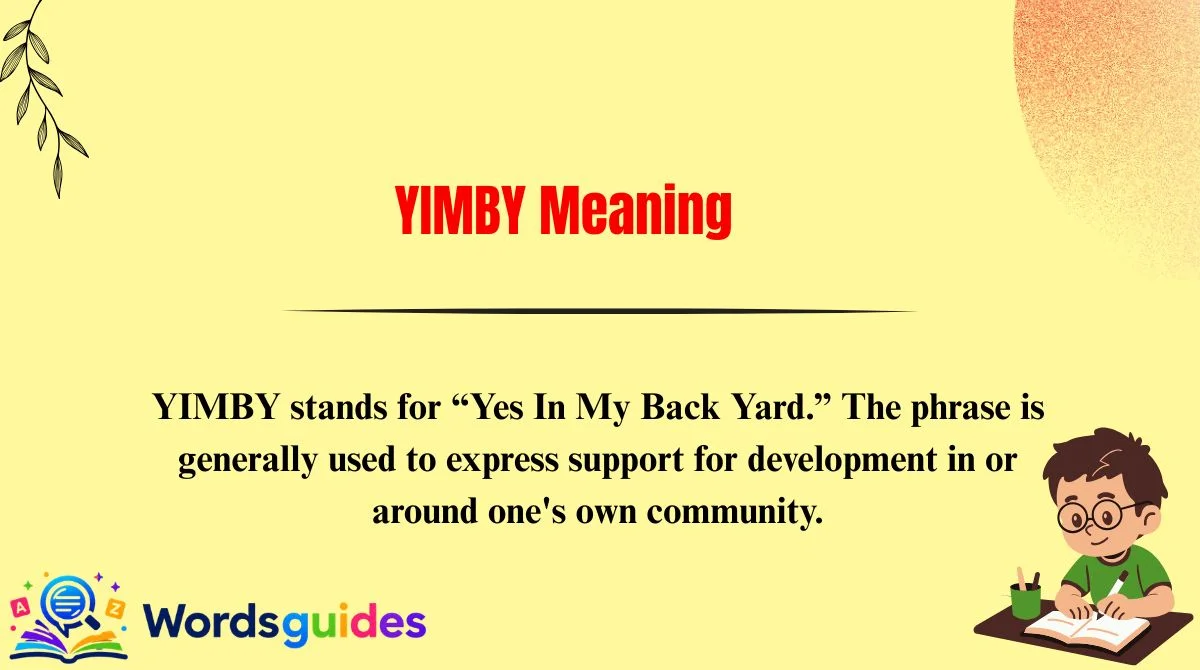
YIMBY stands for “Yes In My Back Yard.” The phrase is generally used to express support for development in or around one’s own community.
In modern discussions, YIMBY most often appears in conversations about housing and urban development, although it can also refer to transportation, renewable energy, schools, public facilities, or other community projects.
Simple Definition
A YIMBY is a person who supports a particular type of development being allowed nearby rather than automatically opposing it because it is local.
For example:
“I’m YIMBY when it comes to building more apartments near transit.”
This means the speaker supports additional apartments in that area.
How Do You Pronounce YIMBY?
YIMBY is commonly pronounced “YIM-bee” /ˈjɪmbi/.
It can be written as YIMBY or yimby. When referring to people, YIMBYs is the common plural form.
What Tone Does YIMBY Have?
YIMBY is usually informal but not inherently rude or offensive. It is commonly used as a descriptive label in conversations about housing, planning, and local development.
Depending on the conversation, someone may use it neutrally, proudly, critically, or humorously. The surrounding words usually make the intended attitude clear.
Origin and Background of YIMBY
YIMBY developed as a counterpart to NIMBY, the abbreviation for “Not In My Back Yard.” Dictionary sources place the first recorded use of YIMBY in the 1990s, while historical references show the term was already being used in discussions about development during that period.
The exact early history is somewhat broader than today’s housing-focused use. Earlier examples used YIMBY for support of various community projects, while its modern public meaning is strongly associated with housing development and land-use policy.
Organized YIMBY activism became particularly visible in the San Francisco Bay Area during the 2010s, where housing affordability and restrictions on new housing became major subjects of public debate.
How YIMBY Is Used in Text Conversations
YIMBY is less common as everyday casual texting slang than abbreviations such as “LOL” or “BRB.” Instead, you are more likely to encounter it in conversations about housing, cities, politics, urban planning, or community development.
Friendly or Casual Use
Person A: “They want to add apartments near the train station.”
Person B: “I’m pretty YIMBY. More housing there makes sense to me.”
Here, YIMBY simply identifies the person’s position on the development.
Humorous Use
Friend 1: “They’re building a new apartment complex two blocks away.”
Friend 2: “Apparently I’m officially a YIMBY now 😂.”
The speaker may be joking while referring to their support for the project.
Discussion or Debate
Person A: “Are you NIMBY or YIMBY on this proposal?”
Person B: “Neither automatically. I want to see the details first.”
In this context, YIMBY is being used as a label within a discussion about development.
Negative or Critical Use
Someone might use “YIMBY” critically when they disagree with a person’s approach to development. That does not change the basic meaning of the term; the speaker’s attitude comes from the surrounding context.
What Does YIMBY Mean on Different Platforms?
YIMBY generally keeps the same core meaning across platforms. The main difference is where you are likely to encounter it.
| Platform | Typical Context |
|---|---|
| Local housing, neighborhood, or community discussions | |
| Snapchat | Less common; may appear when discussing local development |
| Posts or comments about housing, cities, and urban projects | |
| TikTok | Videos explaining housing, zoning, cities, or development debates |
| Community groups and local planning discussions | |
| Discord | Housing, urbanism, city-building, or policy communities |
| Dating apps | Uncommon; usually only relevant if a profile or conversation discusses housing or urban issues |
So, if someone uses YIMBY on Instagram or Discord, you should generally interpret it according to the same “Yes In My Back Yard” meaning rather than assuming it is platform-specific slang.
What Does YIMBY Mean From a Girl or Guy?
YIMBY does not have a different meaning when used by a girl or a guy.
If someone says, “I’m YIMBY,” their gender does not change the definition. The important clues are the subject being discussed, the surrounding messages, punctuation, and tone.
For example:
“I’m YIMBY on new apartments near downtown.”
This is a straightforward statement about development.
By contrast:
“Guess I’m a YIMBY now 😂”
could sound more humorous or casual.
If you see YIMBY on a dating app, it still normally refers to the person’s views about development or housing, not a romantic code.
Other Possible Meanings of YIMBY
YIMBY has a few documented uses, but “Yes In My Back Yard” is the standard meaning readers are most likely to encounter today.
| Meaning | Context | Example |
|---|---|---|
| Yes In My Back Yard | Housing, development, infrastructure, community planning | “She describes herself as YIMBY.” |
| Yes In Many Backyards | Older or less common usage connected with distributing responsibility for projects | “The proposal takes a YIMBY approach.” |
The “Yes In Many Backyards” expansion appears in historical sources, but it is much less common than “Yes In My Back Yard.”
How to Respond to YIMBY
Your response should depend on whether you agree, disagree, or simply want clarification.
Casual
“Oh, so you support more housing development?”
Friendly
“Got it. I’ve heard YIMBY before but wasn’t sure what it meant.”
Curious
“YIMBY for what kind of development?”
Neutral
“Interesting. What makes you support that particular project?”
Funny
“So you’re officially saying yes to the backyard? 😂”
If You Disagree
“I understand your point, but I have some concerns about this particular proposal.”
If You Are Confused
“Wait, what does YIMBY stand for?”
The best response depends more on the specific project and conversation than on the abbreviation itself.
Similar Texting Terms and Differences
| Term | Meaning | Key Difference |
|---|---|---|
| NIMBY | Not In My Back Yard | Describes opposition to nearby development |
| YIMBY | Yes In My Back Yard | Describes support for nearby development |
| IMBY | In My Back Yard | Less common; focuses on something being located locally |
| YIGBY | Yes In God’s Back Yard | A related phrase used in discussions involving religious properties and housing |
| LULU | Locally Unwanted Land Use | Refers to facilities or land uses that communities may consider undesirable |
YIMBY and NIMBY are the most directly related terms. Their contrast is based on whether the speaker supports or opposes a particular type of nearby development.
Common Misunderstandings About YIMBY
One common mistake is assuming that a YIMBY automatically supports every possible development project. That is not necessarily true. Someone may support more housing generally while opposing a particular project because of its design, location, environmental effects, or other concerns.
Another misunderstanding is thinking that YIMBY always means “build anything anywhere.” In actual discussions, people who identify with the term can have different views about what should be built, where it should be built, and under what conditions.
Capitalization can also cause confusion. YIMBY, yimby, and Yimby can refer to the same term.
Finally, “back yard” is generally metaphorical. It usually means one’s neighborhood or local area, not literally building something in someone’s private backyard.
Is YIMBY Appropriate or Safe to Use?
Yes. YIMBY is generally an acceptable informal term and is not inherently offensive, sexual, threatening, or unsafe.
It is most appropriate in conversations where housing, planning, infrastructure, zoning, transportation, or local development is being discussed.
In a workplace or formal setting, you may want to explain the term the first time you use it:
“I generally support a YIMBY, or ‘Yes In My Back Yard,’ approach to housing.”
That makes the meaning clear to readers who are unfamiliar with the acronym.
Because YIMBY can describe a position in a public policy debate, it is also useful to distinguish between the definition of the term and disagreements about whether a particular development is beneficial or harmful. The word itself does not establish that a project is good or bad.
Examples of YIMBY in Text
- “I’m definitely YIMBY when it comes to apartments near the subway.”
- “My brother keeps talking about YIMBY policies and housing supply.”
- “Are you YIMBY or NIMBY on the new development?”
- “I never knew what YIMBY meant until I started following urban planning accounts.”
- “She called herself a YIMBY during the neighborhood meeting.”
- “YIMBY doesn’t necessarily mean supporting every single building proposal.”
- “That TikTok explained the YIMBY vs. NIMBY debate really well.”
- “I guess I’m a YIMBY on this one. We need more homes around here.”
- “He used YIMBY in the group chat, and I had to Google it.”
- “The article discussed YIMBY ideas alongside zoning reform.”
- “Wait, YIMBY means Yes In My Back Yard, right?”
- “I’m not against development, but I don’t think every proposal deserves automatic YIMBY support.”
Frequently Asked Questions
What does YIMBY stand for?
YIMBY stands for “Yes In My Back Yard.” It is used for people or positions that support allowing development in a local area, particularly housing. The term can also apply more broadly to infrastructure, transportation, energy, or other community projects.
Is YIMBY the opposite of NIMBY?
Yes. YIMBY and NIMBY are commonly presented as opposing terms. YIMBY means “Yes In My Back Yard,” while NIMBY means “Not In My Back Yard.” YIMBY generally indicates support for nearby development, whereas NIMBY is associated with opposition to particular developments in one’s local area.
Is YIMBY a political term?
YIMBY can be used in political and public-policy discussions, especially those involving housing, zoning, land use, and development. However, the word itself is primarily a label describing a position or movement. People can use it in casual conversations, community discussions, journalism, or debates about local projects.
Does YIMBY mean supporting every new building?
No. Identifying as YIMBY does not automatically mean agreeing with every development proposal. A person can generally support additional housing or development while still questioning a specific project’s location, design, environmental impact, affordability, infrastructure requirements, or other characteristics.
How do you pronounce YIMBY?
YIMBY is usually pronounced “YIM-bee.” The pronunciation is /ˈjɪmbi/. You may see the term written in uppercase as YIMBY or lowercase as yimby. Both forms refer to the same expression.
What is a YIMBY person?
A YIMBY can refer to someone who supports nearby development, particularly the construction of additional housing. The term can also be used as an adjective, such as “a YIMBY position,” when describing a stance that favors allowing development in a local area.
Conclusion
YIMBY means “Yes In My Back Yard” and is most commonly associated with support for housing and other forms of local development.
It is often contrasted with NIMBY, or “Not In My Back Yard.” Although you may see YIMBY on social media, in group chats, or online discussions, its meaning generally stays the same across platforms.
The best way to understand the speaker’s exact position is to look at the project or issue being discussed. In most cases, YIMBY is an informal, non-offensive term describing support for nearby development.

I am Lily Anderson, an English language writer passionate about explaining word meanings, vocabulary, grammar, pronunciation, and language usage through clear, accurate, and easy-to-understand educational content for learners worldwide.