The mental breakdown meaning usually refers to a period when someone feels emotionally or mentally overwhelmed and struggles to cope with everyday life.
People may use the phrase when they are under intense stress, exhausted, anxious, or dealing with a difficult situation.
In everyday conversation, “mental breakdown” is an informal expression rather than a specific medical diagnosis. Someone might say, “I’m having a mental breakdown,” after a stressful week, while another person may use it to describe a much more serious period of emotional distress.
The meaning depends heavily on context. In texts, social media posts, and casual conversations, the phrase can sometimes be exaggerated or used humorously.
However, it can also be a genuine sign that someone needs support. Understanding the surrounding words and tone is important before deciding how to respond.
Quick Answer
Mental breakdown means a period of severe emotional or mental distress in which a person feels unable to cope normally with stress or daily responsibilities. It is an informal phrase, not a formal medical diagnosis. In texting, it can describe anything from feeling extremely overwhelmed to experiencing serious emotional difficulties.
What Does Mental Breakdown Mean in Text?
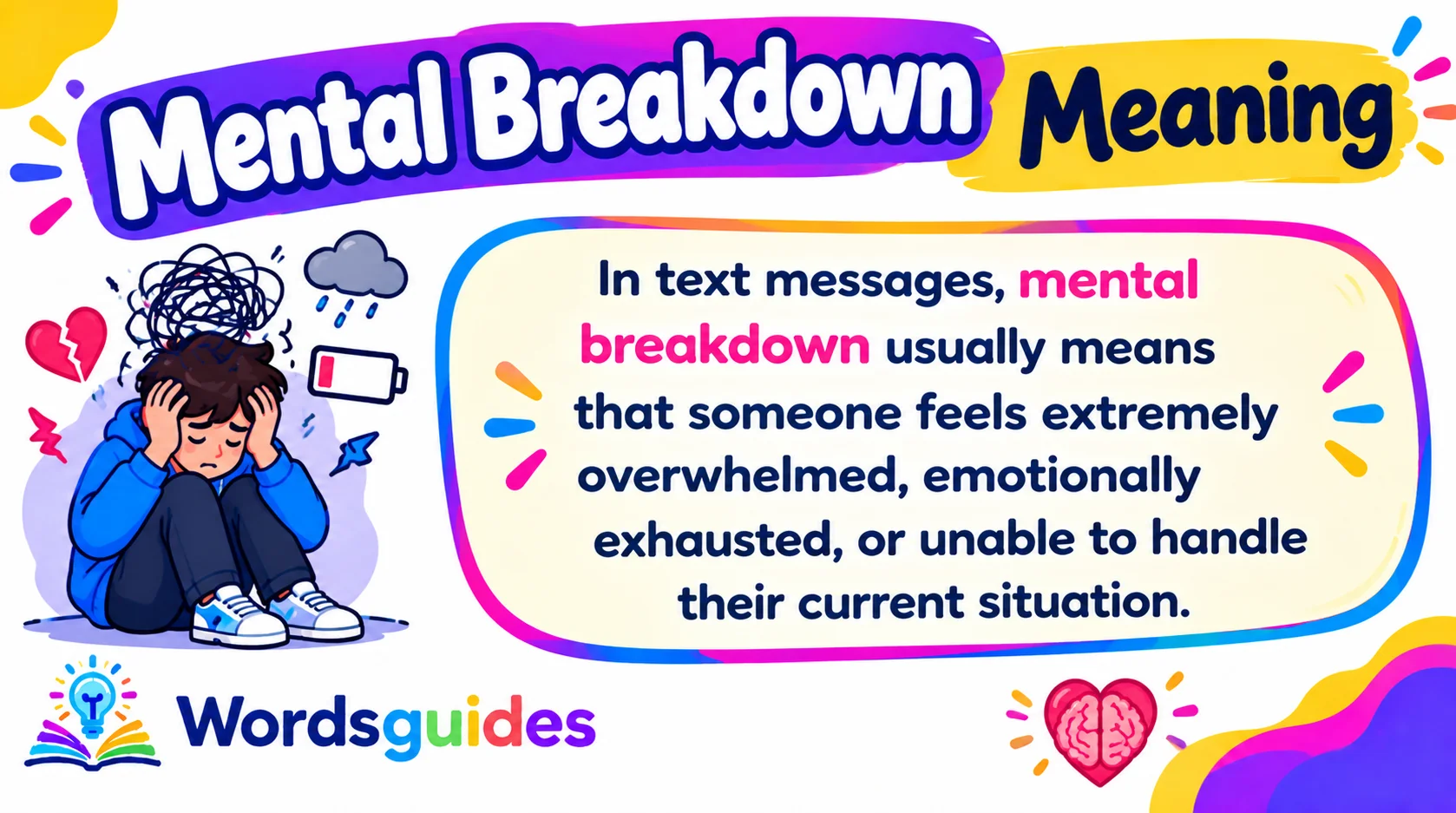
In text messages, mental breakdown usually means that someone feels extremely overwhelmed, emotionally exhausted, or unable to handle their current situation.
The phrase does not have a full form because it is not an abbreviation. It is a common English expression made from “mental,” relating to the mind or emotions, and “breakdown,” suggesting that normal coping has become difficult.
Simple Definition
A mental breakdown is a period of intense emotional or psychological distress that can make ordinary activities feel unusually difficult.
Someone experiencing this kind of distress may have trouble concentrating, sleeping, working, studying, making decisions, or managing emotions. The exact experience varies from person to person.
Pronunciation
Mental breakdown is pronounced approximately:
MEN-tuhl BRAYK-down
Tone and Emotional Meaning
The phrase can have several tones:
- Serious: “I think I’m having a mental breakdown.”
- Casual: “I’m going to have a mental breakdown over these exams.”
- Humorous or exaggerated: “My Wi-Fi stopped working. Mental breakdown!”
- Concerned: “You’ve been under so much pressure. Are you okay?”
The surrounding conversation tells you whether the person is joking, exaggerating, or describing genuine distress.
Text Example
Person A: “How are you doing with all those assignments?”
Person B: “Honestly, I feel like I’m having a mental breakdown.”
Here, the person is probably saying that the workload feels extremely overwhelming. It does not automatically tell you whether they are experiencing a particular mental health condition.
Origin and Background of Mental Breakdown
“Breakdown” has long been used in English to describe something that stops functioning properly or loses its usual ability to operate. Over time, similar language became associated with people who were struggling to cope emotionally or psychologically.
The phrase mental breakdown became common in everyday English as a general way to describe severe emotional distress. However, it is not the official name of a single psychiatric disorder.
Today, people use the expression in both serious and casual settings. Because its meaning can range from genuine distress to exaggeration, context is especially important when it appears in a text or social media post.
How Mental Breakdown Is Used in Text Conversations
People may use “mental breakdown” when talking about school, work, relationships, family problems, money, exhaustion, or other stressful situations.
Serious Use
A: “You haven’t seemed like yourself lately.”
B: “I’ve been dealing with so much at home. I think I’m having a mental breakdown.”
In this situation, the phrase should be taken seriously rather than treated as a joke.
Casual Use
A: “How’s the project going?”
B: “Terrible. Three deadlines this week. I’m having a mental breakdown 😂”
The person may simply mean they are extremely stressed.
Humorous or Exaggerated Use
A: “I accidentally deleted my presentation.”
B: “Nooo, I would have a mental breakdown.”
Here, the expression may be hyperbole. The person is emphasizing how upsetting the situation would feel.
Supportive Use
A: “I can’t deal with everything anymore.”
B: “I’m sorry you’re going through this. Do you want to talk?”
A supportive response is more appropriate when the message sounds genuinely distressed.
Romantic or Relationship Context
The phrase itself is not romantic. Someone might mention a mental breakdown while discussing relationship stress, such as:
“We’ve been arguing every day, and I’m honestly having a mental breakdown.”
The relationship context explains why the person feels overwhelmed; the phrase does not carry a special romantic meaning.
What Does Mental Breakdown Mean on Different Platforms?
The basic meaning usually stays the same across social and messaging platforms.
On WhatsApp, someone may use the phrase in a private conversation to describe stress, emotional exhaustion, or an overwhelming situation.
Snapchat
On Snapchat, it may appear in a message, caption, or story. Short-lived posts can sometimes use the phrase dramatically or humorously.
Instagram users may write “mental breakdown” in captions, comments, Stories, or direct messages. The surrounding post often helps determine whether the expression is serious or exaggerated.
TikTok
On TikTok, the phrase can appear in captions, comments, or videos about school, work, relationships, stress, or emotional experiences. It may be used seriously or as internet-style exaggeration.
Facebook users may use the expression in personal posts or conversations to describe feeling overwhelmed or emotionally drained.
Discord
On Discord, especially in casual communities, “mental breakdown” may be used jokingly among friends. However, a message describing persistent or severe distress should not automatically be dismissed as humor.
Dating Apps
On dating apps, the phrase generally keeps its ordinary meaning. If someone says they are having a mental breakdown, their tone and the surrounding conversation matter more than the platform itself.
What Does Mental Breakdown Mean From a Girl or Guy?
Being said by a girl or a guy does not change the basic meaning of “mental breakdown.”
The important clues are the situation, relationship between the people, wording, punctuation, emojis, and previous messages.
For example:
“I’m having a mental breakdown 😭”
could be a serious expression of distress, while:
“This homework is giving me a mental breakdown 😂”
is more likely to be casual exaggeration.
Do not assume that someone is joking simply because they use an emoji. Likewise, do not assume that every use describes a clinical mental health condition.
Other Possible Meanings of Mental Breakdown
“Mental breakdown” does not have several distinct dictionary meanings in texting. Instead, its use usually falls into different contextual categories.
| Meaning | Context | Example |
|---|---|---|
| Severe emotional distress | Serious personal situation | “I feel like I’m having a mental breakdown.” |
| Feeling overwhelmed | School, work, or responsibilities | “These deadlines are causing a mental breakdown.” |
| Emotional exhaustion | Long-term pressure or difficult circumstances | “I haven’t slept properly and I’m breaking down.” |
| Exaggerated frustration | Casual or humorous conversation | “My laptop crashed. Mental breakdown!” |
The most common texting use is a broad expression for feeling extremely overwhelmed or emotionally distressed.
How to Respond to Mental Breakdown
The best response depends on whether the person sounds serious, casual, or humorous.
Casual Reply
“That sounds rough. What happened?”
Friendly Reply
“You’ve got this. Take a break and breathe for a minute.”
Funny Reply
If the context is clearly joking:
“Okay, emergency snack break first.”
Caring Reply
“I’m here if you want to talk about it.”
Romantic Reply
If you are close to the person:
“I’m here for you. You don’t have to deal with everything alone.”
Confused Reply
“Wait, are you joking or are you actually feeling really overwhelmed?”
This can be useful when the person’s tone is unclear.
Serious Reply
“I’m really sorry you’re feeling this way. Are you safe right now?”
If someone appears to be in serious emotional distress, a direct and caring check-in is more appropriate than making jokes.
Similar Texting Terms and Differences
| Term | Meaning | Key Difference |
|---|---|---|
| Burnout | Exhaustion caused by prolonged stress | Often linked to ongoing work, study, or caregiving demands |
| Overwhelmed | Feeling unable to manage everything | Broader and usually less intense than “mental breakdown” |
| Breaking down | Losing emotional control or becoming extremely distressed | Often describes an emotional moment or process |
| Stress out | Become very worried or tense | Usually more casual and less severe |
| Crisis | A serious situation requiring immediate attention or action | Can refer to mental health or many other types of emergencies |
These expressions overlap, but they are not exact synonyms.
Common Misunderstandings
One common mistake is assuming that “mental breakdown” is a formal medical diagnosis. It is not the official diagnosis of one specific mental disorder.
Another misunderstanding is treating every use as equally serious. Someone might say “I’m having a mental breakdown” because of an exam, a broken phone, or a difficult day, while another person may use the same words to describe profound emotional distress.
Capitalization does not normally change the meaning. “Mental breakdown,” “mental Breakdown,” and “MENTAL BREAKDOWN” generally communicate the same idea, although all caps can make the message feel more intense.
Emojis can also change the apparent tone, but they should not be treated as definitive proof that someone is joking.
Is Mental Breakdown Appropriate or Safe to Use?
“Mental breakdown” is an informal expression. It is generally acceptable in casual conversation, texting, and social media, but it is usually not the best wording for formal medical or workplace communication.
Because the phrase can describe serious emotional distress, avoid using it carelessly when someone appears genuinely overwhelmed. In professional settings, clearer language such as “I’m experiencing significant stress” may be more appropriate.
It is also important not to assume that the phrase automatically means someone is suicidal or intends to harm themselves. At the same time, if a person talks about self-harm, suicide, feeling unsafe, or being unable to stay safe, take those statements seriously and encourage immediate help from a trusted person, a mental health professional, or local emergency/crisis services.
Examples of Mental Breakdown in Text
- “I have three exams tomorrow. I’m having a mental breakdown.”
- “Please give me ten minutes. My brain is completely overwhelmed.”
- “She called me after work and said she was close to having a mental breakdown.”
- “I lost my entire assignment five minutes before submitting it. Mental breakdown 😭”
- “Are you okay? Your messages sound like you’re really struggling.”
- “This week has been nonstop. I seriously need a day off.”
- “I thought I was fine, but everything suddenly became too much.”
- “My little brother ate the last slice of pizza. Mental breakdown officially activated 😂”
- “I’m not joking this time. I genuinely feel like I can’t cope.”
- “The breakup, work, and lack of sleep have all become too much for me.”
- “You can talk to me if you need someone. No judgment.”
- “That deadline almost gave me a mental breakdown, but I finally finished.”
FAQs
Is mental breakdown a medical term?
No. “Mental breakdown” is a common informal expression rather than the official name of a specific mental health diagnosis. People use it broadly to describe a period of severe stress, emotional distress, exhaustion, or difficulty coping. A qualified mental health professional can determine whether someone is experiencing a particular mental health condition.
What does “I’m having a mental breakdown” mean?
It usually means the person feels extremely overwhelmed or emotionally distressed and believes they are struggling to cope. The seriousness depends on context. Sometimes the phrase is casual exaggeration about school or work, while other times it describes genuine and significant emotional difficulties.
Is saying “mental breakdown” offensive?
The phrase is not inherently offensive, but it can be insensitive when used as a joke about someone else’s genuine mental health difficulties. In casual conversation, people commonly use it to describe feeling overwhelmed. When someone appears seriously distressed, respond with care instead of assuming they are exaggerating.
What is the difference between a mental breakdown and burnout?
Burnout generally refers to physical and emotional exhaustion associated with prolonged or repeated stress, often involving work, school, or caregiving. “Mental breakdown” is a broader informal phrase for severe emotional or psychological distress. The two can overlap, but they do not mean exactly the same thing.
How should I respond if someone texts “I’m having a mental breakdown”?
Start by checking what they mean. You could say, “Are you okay?” or “Do you want to talk about what’s happening?” If they describe serious distress or say they may hurt themselves, treat the situation as urgent and encourage them to contact immediate local support or a trusted person.
Can “mental breakdown” be used jokingly?
Yes. People often use it as exaggeration for frustrating situations, such as losing a file or facing a difficult exam. However, the same words can describe real emotional suffering. If you cannot tell which meaning applies, asking a gentle question is safer than assuming it is a joke.
Conclusion
The mental breakdown meaning is generally a period of intense emotional or psychological distress in which someone feels unable to cope normally. In texting, the phrase can describe genuine suffering, everyday overwhelm, or humorous exaggeration.
It is not a formal medical diagnosis, and its meaning depends on context, wording, and tone. When the message sounds serious, respond with empathy and check on the person rather than dismissing it as drama.
When the context is clearly casual, a lighter response may be appropriate. Looking at the whole conversation is the best way to understand what the sender means.

I am Lily Anderson, an English language writer passionate about explaining word meanings, vocabulary, grammar, pronunciation, and language usage through clear, accurate, and easy-to-understand educational content for learners worldwide.