Understanding patients meaning is important because the word is commonly used in healthcare, hospitals, clinics, insurance documents, and everyday conversations.
Patients is the plural form of patient, referring to people who receive medical care, treatment, or advice from healthcare professionals.
It is one of the most frequently used medical terms in English, and knowing its correct meaning helps avoid confusion—especially since it is often mistaken for the word patience.
Whether you’re reading a medical report, filling out hospital forms, learning English, or simply curious about the word, this guide explains everything you need to know.
You’ll learn the definition, pronunciation, grammar, examples, common mistakes, and how the word is used in real-life situations.
Quick Answer
| Topic | Information |
|---|---|
| Meaning | People who receive medical care or treatment |
| Singular Form | Patient |
| Plural Form | Patients |
| Pronunciation | PAY-shuhnts (/ˈpeɪ.ʃənts/) |
| Part of Speech | Noun (plural) |
| Category | Medical and Healthcare Vocabulary |
| Common Usage | Hospitals, clinics, healthcare, insurance, education |
| Tone | Neutral and professional |
| Full Form | No full form |
| Common Audience | Doctors, nurses, students, caregivers, general public |
| Reply Needed? | No |
What Does Patients Meaning?
The patients meaning is people who receive medical care, diagnosis, treatment, or advice from doctors, nurses, dentists, therapists, or other healthcare professionals.
The word patients is simply the plural of patient.
For example:
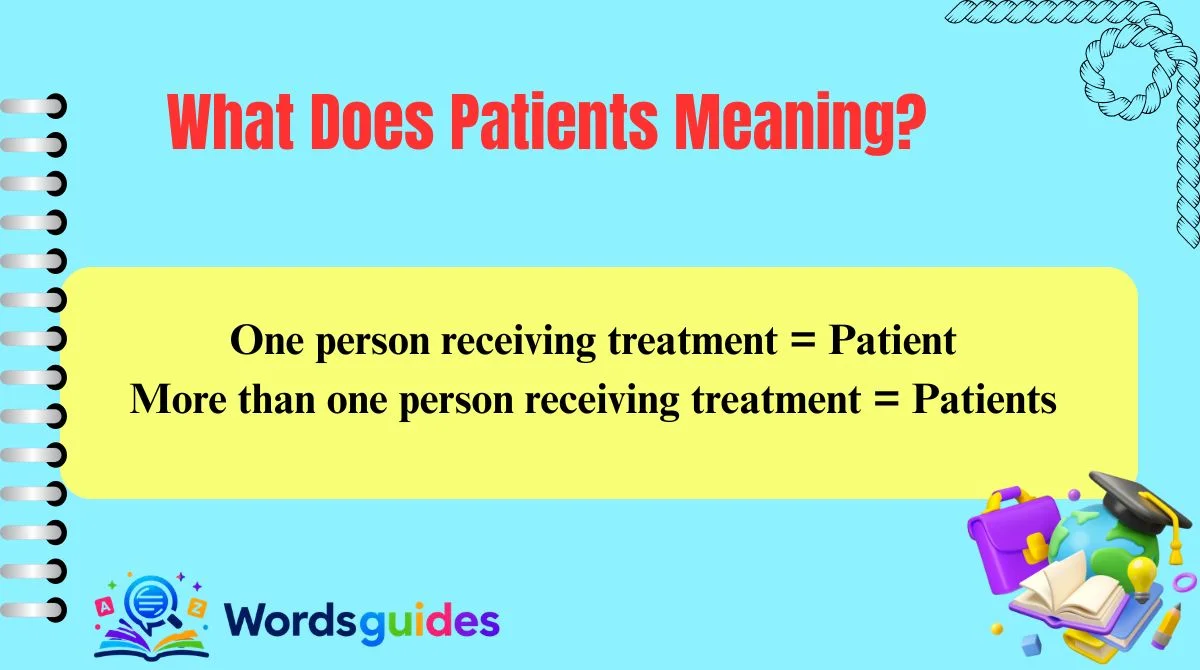
- One person receiving treatment = Patient
- More than one person receiving treatment = Patients
Simple Definition
A patient is someone who is sick, injured, or seeking medical attention.
Patients refers to two or more such people.
Examples
- The doctor examined five patients this morning.
- The hospital cares for hundreds of patients every day.
- Nurses help patients recover after surgery.
- The clinic accepts new patients every week.
In healthcare, the relationship between medical professionals and patients is central to diagnosis, treatment, recovery, and preventive care.
Full Form
The word patients does not have a full form.
It is a standard English noun and is not an abbreviation, acronym, or slang.
- ✅ Patient = Correct
- ✅ Patients = Correct plural
- ❌ Not an acronym
- ❌ No expanded form exists
Origin and Background
The word patient comes from the Latin word patiens, meaning “one who suffers” or “one who endures.”
Historically, the term described someone enduring illness or pain while receiving care.
Over time, its meaning became more specific in medicine and now refers to anyone receiving healthcare services, regardless of whether they are seriously ill.
Today, the word is used worldwide in:
- Hospitals
- Medical clinics
- Dental offices
- Mental health services
- Rehabilitation centers
- Telemedicine
- Home healthcare
As healthcare systems evolved, the focus shifted toward patient-centered care, emphasizing respect, communication, safety, and shared decision-making.
How People Use It
The word patients appears in many everyday healthcare situations.
In Hospitals
Doctors and nurses talk about:
- Admitted patients
- Emergency patients
- Surgical patients
- Intensive care patients
Example:
The emergency department treated 80 patients today.
In Clinics
Receptionists often say:
- New patients are welcome.
- Existing patients can book online.
In Medical Records
Examples include:
- Patient history
- Patient identification
- Patient information
- Patient care plan
In Health Insurance
Insurance companies use terms like:
- Eligible patients
- Covered patients
- Registered patients
In Education
Medical students frequently learn through interactions with patients during clinical training.
Meaning on Different Platforms
People may write:
- The doctor saw many patients today.
- We need to visit the patients tomorrow.
The word keeps its normal medical meaning.
Hospitals often post updates such as:
- Our staff treated over 1,000 patients this month.
Healthcare professionals may share educational content using captions like:
- Helping patients live healthier lives.
Healthcare organizations often discuss:
- Improving patient care
- Patient satisfaction
- Patient safety
Medical Websites
The word commonly appears in:
- Health articles
- Appointment pages
- Medical guides
- Hospital FAQs
Unlike internet slang, patients has the same meaning across all platforms.
Real Conversation Examples
Example 1
Doctor: How many patients are waiting?
Nurse: About ten.
Explanation: Refers to people waiting for medical care.
Example 2
Receptionist: Are you a new patient?
Visitor: Yes, this is my first appointment.
Explanation: A first-time patient visiting the clinic.
Example 3
Doctor: Our patients responded well to the treatment.
Explanation: Multiple people improved after receiving care.
Example 4
Teacher: Medical students must always respect their patients.
Explanation: Highlights professional ethics.
Example 5
Family Member: Can visitors meet patients after surgery?
Nurse: Yes, during visiting hours.
Explanation: Refers to hospitalized individuals.
Example 6
Dentist: We recommend regular checkups for all patients.
Explanation: Advice given to everyone receiving dental care.
Example 7
Hospital Manager: Patient safety comes first.
Employee: Absolutely.
Explanation: Focuses on protecting patients from harm.
Example 8
Friend: Why is the waiting room crowded?
Friend: There are many patients today.
Explanation: Many people are waiting for treatment.
Example 9
Doctor: Some patients recover faster than others.
Explanation: Recovery varies among individuals.
Example 10
Clinic Staff: We are accepting new patients.
Explanation: The clinic welcomes new people seeking healthcare.
When Should You Use It?
Use patients whenever referring to more than one person receiving healthcare.
Common situations include:
- Talking about hospitals
- Discussing medical treatment
- Writing healthcare reports
- Reading health news
- Studying medicine
- Hospital administration
- Insurance paperwork
- Medical research
Examples:
- The hospital admitted twenty patients.
- Doctors monitor patients closely.
- Nurses educate patients about medication.
When Should You Avoid Using It?
Avoid using patients when talking about:
- Only one person (use patient instead)
- The personality trait patience
- Non-medical situations where another word fits better
Incorrect:
- She has lots of patients.
Correct:
- She has lots of patience.
Incorrect:
- The patient are waiting.
Correct:
- The patients are waiting.
Is It Rude, Offensive, or Flirty?
No.
The word patients is:
- Professional
- Neutral
- Respectful
- Widely accepted
It is standard vocabulary in medicine.
However, healthcare professionals often use person-first language where appropriate, such as:
- People receiving treatment
- People with diabetes
- Individuals receiving care
This approach emphasizes the person rather than the condition.
Other Meanings (If Any)
The primary and overwhelmingly common meaning of patients relates to healthcare.
There are no widely accepted alternative meanings for the plural noun patients in standard English.
A common source of confusion is the similar-looking word patience, which means the ability to stay calm or tolerate delays.
Patient (Adjective)
The word patient can also be an adjective meaning calm or willing to wait.
Example:
- She is very patient with children.
This is different from the noun patient, which refers to someone receiving medical care.
Similar Words and Related Terms
| Word | Meaning | Usage | Tone |
| Patient | One person receiving medical care | Healthcare | Neutral |
| Patients | More than one person receiving care | Healthcare | Neutral |
| Patience | Ability to remain calm | Everyday English | Neutral |
| Client | Person receiving professional services | Business, counseling | Professional |
| Resident | Person living in a care facility | Healthcare | Neutral |
| Outpatient | Receives treatment without staying overnight | Medical | Professional |
| Inpatient | Stays in a hospital during treatment | Medical | Professional |
| Care Recipient | Person receiving care | Healthcare | Formal |
Common Mistakes
Many English learners confuse patients with similar words.
1. Confusing Patients with Patience
Incorrect:
- She has many patients with her children.
Correct:
- She has a lot of patience with her children.
2. Using Patient Instead of Patients
Incorrect:
- Three patient arrived.
Correct:
- Three patients arrived.
3. Incorrect Verb Agreement
Incorrect:
- Patients is waiting.
Correct:
- Patients are waiting.
4. Wrong Pronunciation
Some learners pronounce it like “pay-tee-ents.”
Correct pronunciation:
PAY-shuhnts
5. Assuming It Has a Full Form
It does not.
Patients is simply the plural noun of patient.
FAQs
What is the meaning of patients?
Patients are people who receive medical care, treatment, diagnosis, or healthcare services from medical professionals.
Is patients singular or plural?
It is the plural form of patient.
What is the singular of patients?
The singular form is patient.
Does patients have a full form?
No. It is a regular English word and not an abbreviation.
What is the difference between patient and patients?
Patient refers to one person receiving medical care, while patients refers to two or more people receiving medical care.
What is the difference between patients and patience?
Patients means people receiving healthcare.
Patience means the ability to remain calm while waiting or dealing with difficulties.
Is patients only used in hospitals?
No. The word is also used in clinics, dental offices, therapy centers, rehabilitation facilities, nursing homes, and telemedicine services.
Can a healthy person be called a patient?
Yes. Someone attending a routine health checkup, vaccination, screening, or preventive consultation may still be considered a patient because they are receiving healthcare services.
Is patients a formal word?
Yes. It is a standard, professional English word used in healthcare, education, research, and everyday communication.
Why do people confuse patients and patience?
The two words look and sound similar, but they have completely different meanings. One relates to healthcare, while the other describes a personal quality of staying calm.
Conclusion
The patients meaning is simple but essential to understand. It refers to more than one person receiving medical care, treatment, diagnosis, or healthcare services.
As the plural form of patient, it appears daily in hospitals, clinics, insurance documents, medical research, and conversations about health.
A common point of confusion is the word patience, which has an entirely different meaning. Remember this easy distinction:
- Patient = one person receiving healthcare.
- Patients = two or more people receiving healthcare.
- Patience = the ability to stay calm.
Knowing the correct meaning and usage of patients will help you communicate more clearly, understand medical information with confidence, and avoid one of the most common English language mistakes.

I am Lily Anderson, an English language writer passionate about explaining word meanings, vocabulary, grammar, pronunciation, and language usage through clear, accurate, and easy-to-understand educational content for learners worldwide.