“Plead the Fifth” means refusing to answer a question because your answer could be used against you, especially in a legal situation.
In everyday conversation, people also use the phrase humorously to avoid answering an embarrassing or personal question.
Many people search for the meaning of “plead the Fifth” after hearing it in courtroom dramas, news reports, podcasts, interviews, or casual conversations.
While the phrase has a legal origin in the United States, it has become part of everyday English and is often used figuratively.
Understanding what “plead the Fifth” means helps you interpret conversations correctly, avoid misusing the phrase, and recognize when someone is making a legal reference versus simply joking.
Whether you came across it on social media, television, or in a real discussion, this guide explains its meaning in plain English with practical examples.
Quick Answer
| Topic | Details |
|---|---|
| Meaning | Refusing to answer a question because the answer could be self-incriminating or personally damaging. |
| Full Form | None (not an abbreviation). |
| Pronunciation | Pleed the Fifth |
| Category | Legal expression and common idiom |
| Tone | Serious in legal settings; humorous or playful in everyday conversations |
| Popularity | Very common in American English |
| Common Platforms | News, TV, interviews, social media, text messages, podcasts |
| Common Audience | English speakers, especially in the United States |
| Common Use | Avoiding difficult, personal, or risky questions |
| Reply Needed? | No, unless you want to continue the conversation |
What Does “Plead the Fifth” Mean?
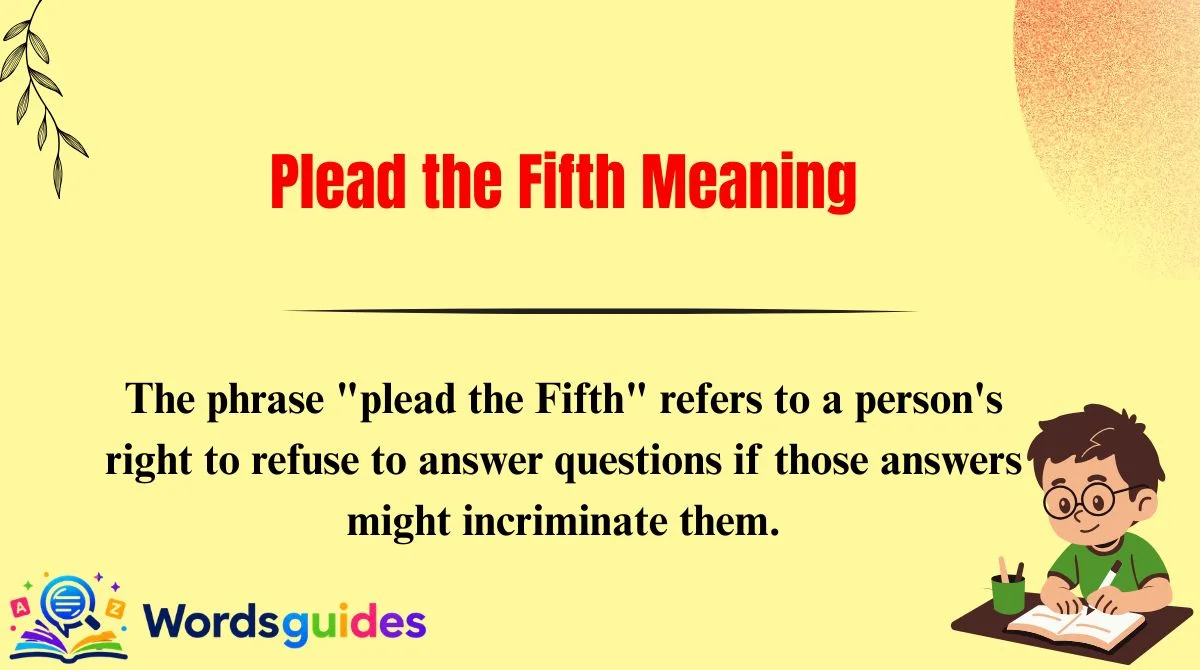
The phrase “plead the Fifth” refers to a person’s right to refuse to answer questions if those answers might incriminate them.
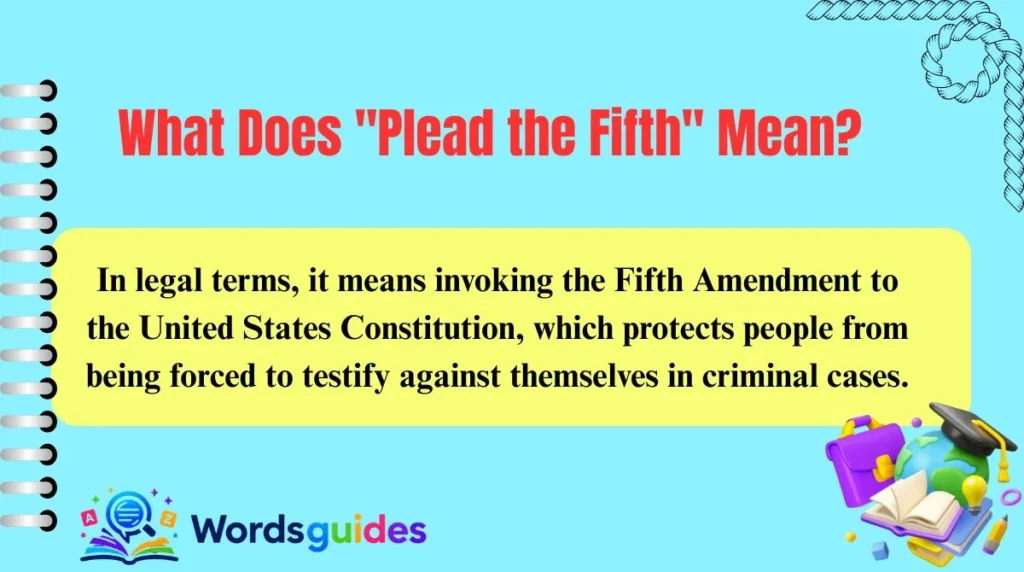
In legal terms, it means invoking the Fifth Amendment to the United States Constitution, which protects people from being forced to testify against themselves in criminal cases.
Literal Meaning
In court or during police questioning, someone may say they are pleading the Fifth to avoid giving testimony that could later be used against them.
Everyday Meaning
Outside the courtroom, people often use the phrase jokingly to avoid answering questions like:
- “How much did that cost?”
- “Who ate the last slice of pizza?”
- “Did you tell your boss what happened?”
In these situations, the speaker is usually not making a legal claim. They’re simply choosing not to answer.
Full Form
“Plead the Fifth” does not have a full form.
It is not an acronym or abbreviation.
The phrase is a shortened way of saying someone is invoking the Fifth Amendment of the U.S. Constitution.
Origin and Background
The expression comes from the Fifth Amendment to the United States Constitution, part of the Bill of Rights, ratified in 1791.
One important part of the amendment protects individuals from being compelled to testify against themselves in criminal proceedings.
Over time, lawyers, judges, journalists, and politicians frequently used the phrase “plead the Fifth.”
Eventually, it entered everyday language and became an idiom meaning:
- “I’d rather not answer.”
- “I’m keeping that information private.”
- “No comment.”
Today, people use it even in situations that have nothing to do with the law.
How People Use It
People use the phrase in several different situations.
During Legal Proceedings
Someone may legally invoke the Fifth Amendment during:
- Court testimony
- Police questioning
- Depositions
- Congressional hearings
In Friendly Conversations
Friends often use it jokingly.
Example:
Alex: Who broke the coffee machine?
Jordan: I plead the Fifth.
Jordan is humorously refusing to answer.
In Interviews
Celebrities or public figures sometimes say:
“I’m going to plead the Fifth on that one.”
This politely avoids discussing a sensitive topic.
At Work
Someone might jokingly avoid office gossip.
Example:
“Who started that rumor?”
“I plead the Fifth.”
Meaning on Different Platforms
People use it when avoiding personal questions.
Example:
“I plead the Fifth 😂”
Meaning:
“I’d rather not answer.”
The phrase appears in captions, comments, and Q&A stories when someone skips an uncomfortable question.
TikTok
Creators often say they “plead the Fifth” while reacting to trending questions, relationship topics, or embarrassing stories.
Users may use it in comment sections when avoiding political or personal discussions.
Text Messages
Friends commonly use it as a humorous response.
Example:
Friend: Did you eat my snacks?
Reply:
I plead the Fifth.
Podcasts and Interviews
Hosts ask difficult questions.
Guests sometimes respond:
“I’m pleading the Fifth.”
This signals they don’t want to answer.
Real Conversation Examples
Example 1
Emma: Who told Mom about the surprise?
Liam: I plead the Fifth.
Explanation: Liam refuses to reveal the answer.
Example 2
Friend: How much did you spend on that watch?
You: I plead the Fifth.
Explanation: You’re jokingly keeping the price secret.
Example 3
Teacher: Who forgot to submit the project?
Student: I plead the Fifth.
Explanation: Usually a joke rather than a legal statement.
Example 4
Reporter: Are you running for office?
Politician: I’ll plead the Fifth on that question.
Explanation: The politician avoids commenting.
Example 5
Sibling: Did you eat my dessert?
Brother: I plead the Fifth.
Explanation: A playful refusal.
Example 6
Coworker: Who left the meeting early?
Employee: I plead the Fifth.
Explanation: Avoiding workplace drama.
Example 7
Friend: Who do you have a crush on?
You: I’m pleading the Fifth.
Explanation: Keeping your feelings private.
Example 8
Host: Which contestant annoyed you most?
Guest: I’ll plead the Fifth.
Explanation: Avoiding controversy.
Example 9
Mom: Did you stay up all night?
Teen: I plead the Fifth.
Explanation: A humorous way of admitting nothing.
Example 10
Colleague: Who made the mistake?
Employee: I’m pleading the Fifth.
Explanation: Choosing not to identify anyone.
When Should You Use It?
The phrase works best when:
- You want to keep something private.
- You’re joking with friends.
- You don’t want to answer a personal question.
- You want to avoid gossip.
- You’re discussing legal rights.
- You’re politely declining to comment.
It can lighten the mood while signaling that you’d rather not answer.
When Should You Avoid Using It?
Avoid using the phrase when:
- People may think you’re making a real legal claim.
- You’re speaking in a country where the Fifth Amendment doesn’t apply.
- A straightforward answer would be more appropriate.
- The situation is very serious and humor could seem disrespectful.
- Someone is asking an important question that requires honesty or clarity.
Remember, casually saying “I plead the Fifth” does not automatically give you legal protection.
Is It Rude, Offensive, or Flirty?
Is It Rude?
Usually, no.
However, repeatedly refusing to answer may come across as dismissive.
Is It Offensive?
No.
The phrase itself is not offensive.
Is It Flirty?
Not by itself.
Sometimes people use it playfully during conversations about dating or crushes, but the phrase has no inherently romantic meaning.
Other Meanings (If Any)
The overwhelming and most common meaning is the legal and idiomatic one described above.
Some people also use “plead the Fifth” simply to mean:
- “No comment.”
- “I’d rather not say.”
- “That’s private.”
These are figurative extensions of the original legal meaning rather than separate definitions.
Similar Expressions and Related Terms
| Expression | Meaning | Typical Usage | Tone |
|---|---|---|---|
| Plead the Fifth | Refuse to answer | Legal and everyday conversation | Serious or playful |
| No comment | Decline to answer | Interviews, media | Neutral |
| I’d rather not say | Politely decline | Everyday conversation | Polite |
| That’s personal | Keep information private | Friends and family | Neutral |
| My lips are sealed | Promise not to reveal information | Casual conversations | Friendly |
| None of your business | Refuse to answer directly | Informal | Can sound rude |
| I’d rather keep that private | Respectfully decline | Professional and personal settings | Polite |
| Pass | Skip answering | Games, conversations | Casual |
Common Mistakes
Thinking It Means Admitting Guilt
Many people assume that saying “I plead the Fifth” means someone is guilty.
That’s incorrect.
Legally, exercising the right against self-incrimination does not automatically indicate guilt.
Using It Outside U.S. Legal Contexts
The phrase specifically refers to the U.S. Constitution.
People in other countries may understand it because of American media, but it doesn’t necessarily apply to their legal systems.
Assuming It Works Everywhere
Saying “I plead the Fifth” in an ordinary conversation has no legal effect.
It’s simply an expression unless used in the proper legal context.
Confusing It With “No Comment”
Although similar, “no comment” is broader.
“Plead the Fifth” specifically references protection against self-incrimination.
Frequently Asked Questions
What does “plead the Fifth” mean in simple words?
It means refusing to answer a question because the answer could get you into trouble or because you simply don’t want to respond.
Is “plead the Fifth” only used in court?
No. While it has a legal origin, people commonly use it jokingly in everyday conversations.
Does pleading the Fifth mean someone is guilty?
No. Using the Fifth Amendment is a constitutional right and does not automatically mean a person has committed a crime.
Can I say “I plead the Fifth” in casual conversation?
Yes. Many people use it humorously to avoid answering personal or awkward questions.
Is “plead the Fifth” an idiom?
Yes. It is both a legal expression and a widely recognized English idiom.
Is there a full form of “plead the Fifth”?
No. It is not an acronym and has no full form.
Why do people say “I plead the Fifth” instead of “no comment”?
The phrase adds a humorous or dramatic touch by referencing a well-known legal right, while “no comment” is more direct.
Can someone outside the United States use the phrase?
Yes. People around the world may use it informally because it is familiar through American culture, though its legal meaning is specific to the U.S.
Is “pleading the Fifth” the same as lying?
No. It means choosing not to answer, not giving a false answer.
Why is the phrase so popular in movies and TV shows?
Courtroom dramas, crime series, political interviews, and news coverage have made the expression widely recognized, even among people who are unfamiliar with U.S. law.
Final Thoughts
“Plead the Fifth” is a well-known expression that originated from the Fifth Amendment of the U.S. Constitution. In legal settings, it refers to the right to refuse answering questions that could be self-incriminating.
In everyday speech, it has evolved into a common idiom for politely—or humorously—declining to answer a question.
The key is understanding the context. In a courtroom, the phrase has a specific legal significance.
Among friends or online, it’s usually a lighthearted way of saying, “I’d rather not answer.” Knowing this distinction helps you interpret conversations more accurately and use the expression appropriately.

I am Lily Anderson, an English language writer passionate about explaining word meanings, vocabulary, grammar, pronunciation, and language usage through clear, accurate, and easy-to-understand educational content for learners worldwide.