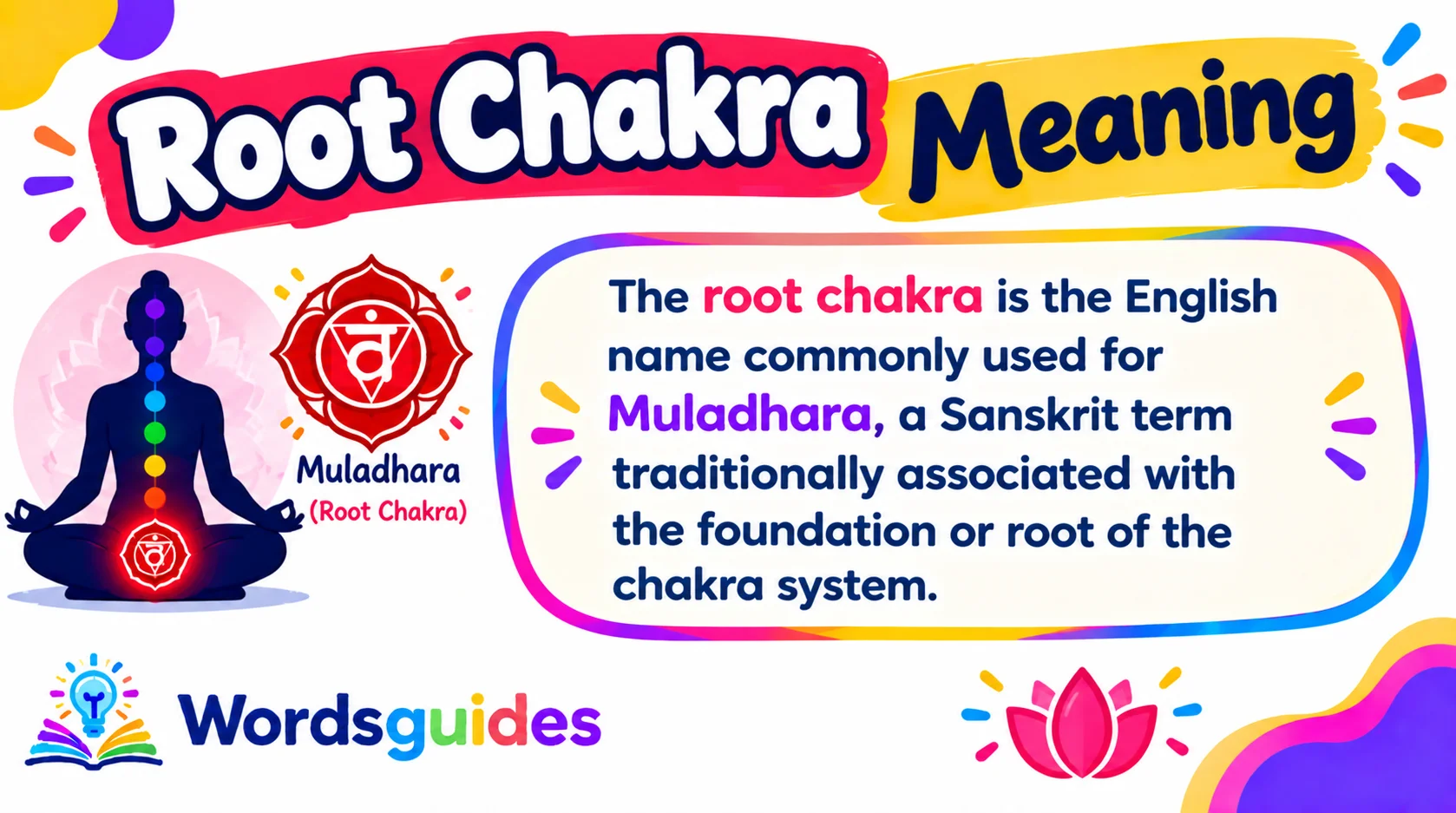
The root chakra meaning is connected with grounding, stability, security, and a sense of being supported.
In Hindu and Buddhist tantric traditions, the root chakra is known as Muladhara, often described as the first or lowest of the seven commonly discussed chakras.
It is traditionally associated with the base of the spine and symbolized by the color red.
People often search for the root chakra because they want to understand its spiritual symbolism, meditation practices, or role in modern wellness.
In chakra-based traditions, it is linked with basic needs such as safety, shelter, stability, and connection to the physical world. Modern wellness discussions may also use the term more broadly to describe feeling grounded and secure.
It is important to remember that chakras are part of spiritual and traditional belief systems, not scientifically established anatomical structures.
Quick Answer
The root chakra, or Muladhara, is traditionally associated with grounding, stability, safety, and basic physical needs. It is described as being located near the base of the spine and is commonly represented by the color red. In spiritual practices, balancing it is believed to support feelings of security and connection to the physical world.
What Does Root Chakra Mean?
The root chakra is the English name commonly used for Muladhara, a Sanskrit term traditionally associated with the foundation or root of the chakra system.
In many modern descriptions, it is considered the first of seven major chakras and is placed near the base of the spine. It is symbolically connected with grounding, stability, survival, security, and belonging.
The word chakra comes from Sanskrit cakra, commonly translated as “wheel” or “disc.” In traditional Indian religious and philosophical systems, chakras are described in different ways depending on the text and tradition.
Pronunciation
Muladhara is commonly pronounced approximately as moo-lah-DHAH-rah, although pronunciation can vary when Sanskrit is represented in English.
“Root chakra” is pronounced simply as:
root CHAK-ruh
What Does the Root Chakra Represent?
In contemporary chakra-based practices, the root chakra is often associated with:
- Physical and emotional security
- Grounding and stability
- Basic needs and survival
- Connection to the body and physical surroundings
- Home and belonging
- A sense of support and steadiness
For example, someone discussing meditation might say:
“I’ve been feeling unsettled lately, so I’m focusing on my root chakra.”
Here, the person is using the term in a spiritual or wellness context, not referring to a medically recognized body part.
Origin and Background of the Root Chakra
The concept of chakras has roots in Indian religious and philosophical traditions, but there is no single ancient chakra system that is identical to the seven-chakra model commonly presented today.
Muladhara appears in traditional Sanskrit sources associated with tantric yoga. Later teachings and modern spiritual movements helped shape the seven-chakra framework that is now widely recognized in English-speaking wellness culture.
Modern descriptions often connect Muladhara with the color red, grounding, and foundational needs. However, specific chakra characteristics can differ between traditions, teachers, and modern interpretations.
Therefore, it is more accurate to view the root chakra as a spiritual and symbolic concept rather than as a scientifically verified physical structure.
How the Root Chakra Is Used in Spiritual and Wellness Conversations
Unlike texting abbreviations, “root chakra” is generally used as a spiritual, meditation, yoga, or wellness term. Its meaning usually depends on what someone is discussing.
In a Spiritual Conversation
A: “What are you meditating on today?”
B: “My root chakra. I’ve been trying to feel more grounded.”
The speaker is referring to a spiritual practice focused on stability and grounding.
In a Casual Wellness Conversation
“I’ve been spending more time outdoors to feel connected and grounded.”
Someone might connect this practice with root-chakra ideas, particularly in yoga or holistic wellness communities.
In a Yoga or Meditation Context
A yoga teacher may discuss the root chakra while guiding students through grounding exercises, breathing practices, meditation, or particular yoga poses.
In a Romantic Conversation
The phrase itself is not inherently romantic or sexual. However, someone might mention the root chakra while talking about emotional security, intimacy, relationships, or feeling safe with another person.
In a Humorous Conversation
Friends may also use chakra terminology playfully:
“After that stressful meeting, my root chakra needs a vacation.”
In this case, the expression is humorous rather than a literal statement about a spiritual practice.
What Does Root Chakra Mean on Different Platforms?
The basic meaning generally stays the same across social platforms. The surrounding conversation determines whether the term is being used seriously, casually, or humorously.
| Platform | Common Context |
|---|---|
| Personal conversations, meditation, yoga, or wellness | |
| Snapchat | Casual discussion, stories, or jokes about spirituality |
| Yoga, meditation, wellness, spirituality, and lifestyle content | |
| TikTok | Spirituality, wellness trends, educational videos, and personal experiences |
| Spiritual groups, wellness communities, and general discussions | |
| Discord | Meditation, spirituality, gaming-community jokes, or interest groups |
| Dating apps | Occasionally used while discussing spirituality, emotional grounding, or personal beliefs |
There is no special texting definition of “root chakra” that changes from one of these platforms to another.
What Does Root Chakra Mean From a Girl or Guy?
Being told about a root chakra by a girl or guy does not create a different definition. Gender does not change what the term means.
The important clues are the person’s words, relationship with you, punctuation, emojis, and the topic of the conversation.
For example:
“I’ve been working on my root chakra lately 🌿”
This may simply indicate an interest in meditation or spirituality.
On the other hand:
“I need to feel grounded again.”
could communicate a similar idea without mentioning chakras at all.
If someone brings up the root chakra while discussing relationships, they may be talking about security or emotional stability. That does not automatically make the message romantic.
Other Possible Meanings of Root Chakra
“Root chakra” does not normally have several unrelated meanings in texting. Its main meaning remains the same, although people may use it in different contexts.
| Meaning | Context | Example |
|---|---|---|
| Muladhara chakra | Spiritual or traditional chakra discussions | “The root chakra is called Muladhara.” |
| Symbol of grounding and stability | Modern wellness | “I’m focusing on my root chakra to feel more grounded.” |
| Metaphorical foundation | Casual or humorous use | “My whole root chakra is stressed today.” |
The most common meaning is the spiritual concept of Muladhara, traditionally associated with the foundation of the chakra system.
How to Respond to Root Chakra
Your response should depend on why the person mentioned it.
Casual Reply
“Oh, are you getting into meditation?”
Friendly Reply
“That sounds interesting. What are you doing to work on it?”
Curious Reply
“I’ve heard of it, but I don’t know much about the root chakra. What does it represent?”
Supportive Reply
“Hope it helps you feel more grounded and relaxed.”
Funny Reply
“Sounds like your root chakra deserves a quiet weekend 😂”
Spiritual Reply
“Grounding sounds like a good focus, especially if things have felt unsettled lately.”
If You Are Confused
“What do you mean by root chakra?”
This is often the best response because it lets the other person explain their own beliefs instead of assuming what they mean.
Similar Terms and Their Differences
| Term | Meaning | Key Difference |
|---|---|---|
| Root chakra | Muladhara, associated with grounding and stability | Focuses on the foundational chakra |
| Sacral chakra | A chakra traditionally associated with creativity, sexuality, and emotions | Traditionally considered the chakra above the root chakra |
| Solar plexus chakra | A chakra commonly associated with personal power and confidence | Focuses more on will and personal agency |
| Heart chakra | A chakra associated with love, compassion, and connection | Centers on emotional connection rather than grounding |
| Crown chakra | A chakra associated with spirituality or higher consciousness | Traditionally placed at the top of the chakra system |
These descriptions reflect traditional and modern chakra interpretations, and details can vary among spiritual systems.
Common Misunderstandings About the Root Chakra
One common mistake is treating the root chakra as if it were a medically recognized organ or anatomical structure. It is not. The term belongs to spiritual and philosophical traditions.
Another misunderstanding is assuming that everyone follows the same seven-chakra system. Chakra teachings vary across historical texts, religious traditions, yoga lineages, and modern wellness practices.
People may also confuse “root chakra” with a medical condition because of references to the spine or pelvic area. Those references are symbolic or traditional and should not be treated as medical explanations.
Capitalization usually does not matter. You may see Root Chakra, root chakra, or root chakra meaning depending on the context.
Is Root Chakra Appropriate or Safe to Use?
“Root chakra” is generally a non-offensive spiritual or wellness term. It is appropriate in casual conversations about yoga, meditation, spirituality, personal beliefs, or holistic practices.
It is not normally a slang insult, sexual expression, or threatening phrase.
However, chakra practices should not be presented as substitutes for professional medical or mental-health care. If someone has a physical or emotional health concern, spiritual practices may be personally meaningful, but they should not replace appropriate professional evaluation or treatment.
Examples of Root Chakra in Text
- “I’m learning about the root chakra in my yoga class.”
- “What does the root chakra actually represent?”
- “I’ve been meditating on grounding and the root chakra.”
- “My friend said I should focus on my root chakra when I feel unsettled.”
- “Is Muladhara another name for the root chakra?”
- “I saw a TikTok about root chakra meditation. Is that part of yoga?”
- “I’m trying to create a calmer routine and reconnect with my root chakra.”
- “The root chakra is usually represented by red, right?”
- “She mentioned her root chakra while talking about feeling more secure.”
- “I don’t really understand chakras, but I’m curious about the root chakra.”
- “After that chaotic week, I need some serious grounding 😂”
- “Can you explain the difference between the root and sacral chakras?”
Frequently Asked Questions
What is the root chakra in simple terms?
The root chakra, traditionally called Muladhara, is a spiritual concept associated with grounding, stability, security, and basic needs. It is commonly described as being located near the base of the spine and is often represented by red. These associations come from spiritual traditions rather than established medical science.
What does the root chakra symbolize?
The root chakra commonly symbolizes stability, grounding, safety, physical existence, and a sense of belonging. In modern wellness practices, people may use the concept when discussing feelings of being secure, settled, or connected to their surroundings. Different chakra traditions may describe its symbolism somewhat differently.
What does Muladhara mean?
Muladhara is the Sanskrit name commonly used for the root chakra. It is often interpreted in relation to a foundation or root. In chakra traditions, Muladhara is generally presented as the foundational chakra and is associated with grounding, stability, and basic needs.
What color is associated with the root chakra?
The root chakra is commonly associated with the color red in modern seven-chakra systems. You may see red imagery, clothing, crystals, artwork, or meditation materials used when discussing it. Color associations are part of the symbolic chakra tradition and are not scientific properties of a physical body structure.
Is the root chakra scientifically proven?
Chakras are part of spiritual and philosophical traditions, but chakras have not been scientifically established as physical structures or energy centers in the body. People may still find chakra meditation or related practices personally meaningful, but spiritual beliefs should be distinguished from scientifically established medical facts.
How do I know if someone is talking about the root chakra?
Look at the surrounding conversation. If the person is discussing yoga, meditation, grounding, spirituality, energy, or wellness, they are almost certainly referring to Muladhara. If the context is unclear, simply ask what they mean rather than assuming a particular interpretation.
Conclusion
The root chakra meaning centers on Muladhara, a traditional spiritual concept associated with grounding, stability, security, and foundational needs.
In modern conversations, people usually mention it when discussing yoga, meditation, spirituality, or wellness.
Its meaning does not change significantly between WhatsApp, Instagram, TikTok, or other platforms. Context matters most, especially when someone connects the idea with relationships or emotional security.
Although chakra beliefs can be meaningful to individuals, they should be understood as spiritual or symbolic traditions rather than scientifically established anatomy.

I am Lily Anderson, an English language writer passionate about explaining word meanings, vocabulary, grammar, pronunciation, and language usage through clear, accurate, and easy-to-understand educational content for learners worldwide.