If you are searching for Sarah meaning, the name is generally understood to mean “lady,” “princess,” or “noblewoman.” Sarah is a feminine name of Hebrew origin and has a long biblical history.
It is especially associated with Sarah, the wife of Abraham in the Old Testament and a major matriarch in Jewish and Christian traditions.
The name is also used widely in English and many other languages, including French, German, Dutch, Scandinavian languages, Arabic, and Hebrew.
Although Sarah has ancient roots, it remains familiar in modern English-speaking countries.
If you are wondering whether “Sarah” has a special meaning in texting, social media, or dating conversations, the answer is usually no.
Sarah is normally simply a person’s name, and its intended meaning depends on the person and context rather than internet slang.
Quick Answer
Sarah means “lady,” “princess,” or “noblewoman.” It comes from the Hebrew name שָׂרָה (Sara) and is best known from the Bible, where Sarah is the wife of Abraham. In modern texting and social media, “Sarah” usually refers to a person named Sarah rather than a special abbreviation or slang term.
What Does Sarah Mean?
Meaning and definition
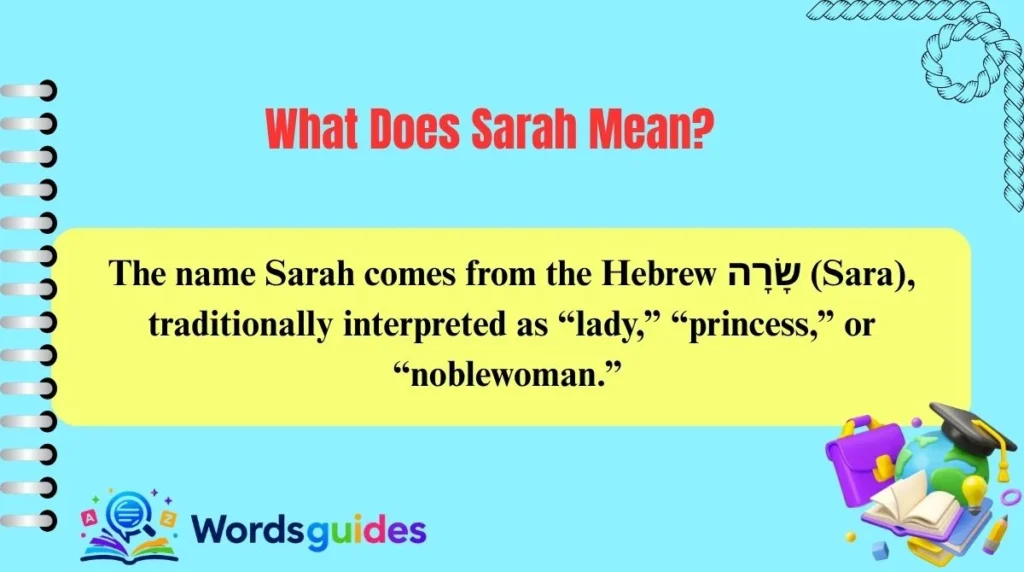
The name Sarah comes from the Hebrew שָׂרָה (Sara), traditionally interpreted as “lady,” “princess,” or “noblewoman.” Some biblical translations also connect the name with the idea of a princess or queen.
Sarah is a feminine given name. It does not have a “full form” in the way an abbreviation such as LOL or BRB does.
How do you pronounce Sarah?
In English, Sarah is commonly pronounced approximately:
- SAIR-uh — /ˈsɛr.ə/
- SARR-uh — /ˈsær.ə/
The exact pronunciation can vary by region, family, and individual preference.
What does Sarah mean in a text message?
If someone writes:
“Sarah will call you later.”
they are almost certainly referring to a person named Sarah. The word does not normally function as texting slang, an abbreviation, or a hidden romantic expression.
The emotional meaning comes from the surrounding conversation. For example, “Sarah!!!” could express excitement, surprise, frustration, or affection depending on the situation.
Origin and Background of Sarah
Sarah has ancient Hebrew and biblical roots. In the Book of Genesis, Sarah is introduced as Abraham’s wife. Her original name was Sarai, and Genesis 17:15 describes her being given the name Sarah.
The two forms are closely related. Biblical notes describe Sarai and Sarah as variant forms associated with the meaning “princess.” One commonly cited explanation is that Sarai carries the sense of “my princess,” while Sarah has the broader sense of “princess.”
Sarah’s biblical significance helped the name remain recognizable across Jewish, Christian, and later European naming traditions. It subsequently became established in many languages and cultures.
How Sarah Is Used in Text Conversations
Because Sarah is a personal name rather than a texting abbreviation, its use is straightforward. People may mention Sarah when talking about a friend, family member, coworker, classmate, celebrity, or romantic partner.
Friendly use
Mia: “Are you coming to the movie tonight?”
Alex: “Yep, Sarah is coming too.”
Here, Sarah simply identifies another person.
Casual use
Tom: “Did Sarah send you the notes?”
Emma: “Not yet. I’ll ask her.”
There is no special slang meaning.
Affectionate or romantic use
Someone might use a person’s name affectionately:
“Sarah, you always know how to make me smile ❤️”
The affectionate meaning comes from the message, relationship, and emoji—not from the name itself.
Humorous or sarcastic use
Names can also be emphasized for humor:
“Sarah… what did you do this time? 😂”
The punctuation and context create the sarcastic or playful tone.
What Does Sarah Mean on Different Platforms?
The meaning of Sarah generally does not change between social media and messaging platforms.
| Platform | Typical meaning of “Sarah” |
|---|---|
| Usually the name of a person in a conversation | |
| Snapchat | Usually a person’s name or username |
| A person’s name, display name, or account name | |
| TikTok | A person’s name, creator name, or username |
| A personal name or profile name | |
| Discord | A person’s name, display name, or nickname |
| Dating apps | Usually the name of the person using the profile |
A username containing “Sarah” can have a creative or personal meaning chosen by its owner. However, Sarah itself does not acquire a different standard slang meaning on these platforms.
What Does Sarah Mean From a Girl or Guy?
The word Sarah does not have a different meaning depending on whether a girl or guy uses it.
If a guy texts, “Sarah is coming too,” he is most likely simply mentioning someone named Sarah. If a girl writes “Sarah!!!,” the extra punctuation may communicate excitement, frustration, or surprise, but that interpretation comes from the context.
When trying to understand a message, look at:
- The words surrounding “Sarah”
- Punctuation such as “!” or “…”
- Emojis
- The relationship between the people involved
- Whether Sarah is being discussed or directly addressed
- The conversation immediately before the message
For example, “Sarah, I miss you ❤️” is affectionate because of the sentence and context, not because the name Sarah has a romantic meaning.
Other Possible Meanings of Sarah
Sarah has a small number of genuine linguistic and cultural variations rather than numerous hidden meanings.
| Meaning | Context | Example |
|---|---|---|
| Lady | Traditional name meaning | “Sarah” is traditionally associated with “lady.” |
| Princess | Hebrew and biblical context | Sarah is traditionally interpreted as “princess.” |
| Noblewoman | Name etymology | Sarah can be explained as “noblewoman.” |
| Sarah as a personal name | Modern everyday use | “Sarah will meet us at six.” |
| Sara | Spelling variant in several languages | “Sara” is a form of Sarah used in various languages. |
The most common meaning in modern communication is simply the person’s given name.
How to Respond to Sarah
Since Sarah is normally a person’s name, your response depends on how the name appears in the conversation.
If someone mentions Sarah
“Oh, Sarah? Yes, I know her.”
If someone asks about Sarah
“I haven’t heard from Sarah yet.”
If someone directly calls your name
“Yes? What’s up?”
If the message is playful
“Sarah 😂 What happened?”
If you are confused
“Which Sarah do you mean?”
If someone uses your name affectionately
“Aww, that’s sweet ❤️”
If the situation is serious
“Is Sarah okay?”
The best response should match the conversation rather than assuming that the name has a hidden meaning.
Similar Names and Their Differences
| Term | Meaning | Key Difference |
|---|---|---|
| Sarah | Lady, princess, noblewoman | Standard English spelling of the name |
| Sara | Form of Sarah | Used as a form of the name in several languages |
| Sarai | “My princess” | Biblical form associated with Sarah before the name change |
| Sahra | Related spelling in some naming traditions | Spelling and cultural usage differ |
| Sadie | Traditionally a diminutive related to Sarah | Separate name form with a different modern history |
Sarah and Sara are especially closely connected. Sarai is the older biblical form associated with Sarah, and biblical sources describe the change from Sarai to Sarah in Genesis 17.
Common Misunderstandings About Sarah
One common mistake is assuming that Sarah is an abbreviation or texting acronym. It is not normally an acronym or internet abbreviation.
Another misunderstanding comes from spelling. Sarah and Sara can represent forms of the same name, while Sarai is the biblical form associated with Sarah before her name change.
Pronunciation can also vary. Some English speakers say “SAIR-uh,” while others use “SARR-uh.” Neither pronunciation automatically changes the meaning of the name.
Finally, context matters when Sarah appears by itself. A message such as “Sarah…” could be affectionate, annoyed, surprised, or simply incomplete. The punctuation and previous messages provide the clues.
Is Sarah Appropriate or Safe to Use?
Yes. Sarah is an ordinary personal name and is generally polite, neutral, and completely appropriate to use.
There is no inherently offensive, sexual, threatening, or unsafe meaning attached to the name in standard English communication. It can be used in casual conversations, school, professional settings, emails, social media, and formal documents.
The only important consideration is personal preference. If someone named Sarah prefers a particular spelling, nickname, or pronunciation, using their preferred form is the respectful choice.
Examples of Sarah in Text
- “Sarah said she’ll be here around 7.”
- “Have you seen Sarah today?”
- “Sarah, can you send me the address?”
- “I think Sarah already knows about the surprise.”
- “Sarah!!! You actually did it 😂”
- “Is Sarah joining us for dinner?”
- “Tell Sarah I said happy birthday!”
- “Sarah… we need to talk about what happened yesterday.”
- “I really miss you, Sarah ❤️”
- “Which Sarah are you talking about?”
- “Sarah just posted the funniest video.”
- “Thanks, Sarah. I really appreciate your help.”
These examples show why context is more important than the name itself when interpreting a message.
Frequently Asked Questions
What is the exact meaning of the name Sarah?
Sarah is a Hebrew name traditionally meaning “lady,” “princess,” or “noblewoman.” It is especially associated with the biblical Sarah, the wife of Abraham. Biblical translations and notes commonly connect the name with “princess,” while related interpretations include “lady” and “noblewoman.”
Is Sarah a biblical name?
Yes. Sarah is a prominent biblical name. In Genesis, Sarah is Abraham’s wife and the mother of Isaac. The biblical account says that her earlier name was Sarai before she was called Sarah.
What does Sarah mean in Hebrew?
In Hebrew, Sarah is written שָׂרָה and is traditionally explained as meaning “lady,” “princess,” or “noblewoman.” The related biblical name Sarai is associated with “my princess.”
Does Sarah have a special meaning in texting?
Usually, no. In texts, WhatsApp messages, social media posts, and chats, Sarah normally functions as a person’s name. If someone gives the name an emotional meaning, such as affection or sarcasm, that comes from the surrounding words, punctuation, emojis, and relationship.
Is Sara the same as Sarah?
Sara is a form of Sarah used in several languages and naming traditions. The spelling differs, but the names are closely related. Sarah is the familiar English spelling, while Sara is common in a range of languages, including Spanish, Italian, Portuguese, and others.
What was Sarah’s name before Sarah?
According to Genesis 17:15, Sarah was previously called Sarai. The biblical passage describes the change from Sarai to Sarah. The two names are closely related, with Sarai traditionally explained as “my princess” and Sarah as “princess.”
Conclusion
The Sarah meaning is traditionally “lady,” “princess,” or “noblewoman,” making it a name associated with dignity and status.
Its strongest historical connection is to the biblical Sarah, wife of Abraham and mother of Isaac.
In modern conversations, however, Sarah is usually nothing more complicated than a person’s name. It does not normally have a special texting, Snapchat, Instagram, or dating-app meaning.
When interpreting a message containing Sarah, focus on the surrounding words, punctuation, emojis, and relationship rather than assuming the name itself carries hidden slang.

I am Lily Anderson, an English language writer passionate about explaining word meanings, vocabulary, grammar, pronunciation, and language usage through clear, accurate, and easy-to-understand educational content for learners worldwide.