The crystals meaning can vary depending on whether you are talking about science, jewelry, spirituality, or everyday language.
In the simplest sense, crystals are solid materials whose atoms or molecules are arranged in an organized, repeating pattern. Many natural crystals form inside rocks, minerals, and geological deposits.
People also use the word “crystals” when discussing gemstones, healing traditions, meditation, decoration, and personal symbolism.
For example, quartz, amethyst, rose quartz, and clear quartz are commonly called crystals.
If you saw “crystals” in a social media post, message, product description, or conversation, the surrounding context matters. It may refer to actual mineral specimens, jewelry, or the symbolic meanings people associate with particular stones.
Quick Answer
Crystals are solid substances with an organized internal structure, often formed naturally from minerals. In everyday conversation, “crystals” can also mean gemstones or stones used for jewelry, decoration, meditation, or spiritual symbolism. Their scientific properties are measurable, while spiritual meanings are based on cultural or personal beliefs.
What Does Crystals Mean?
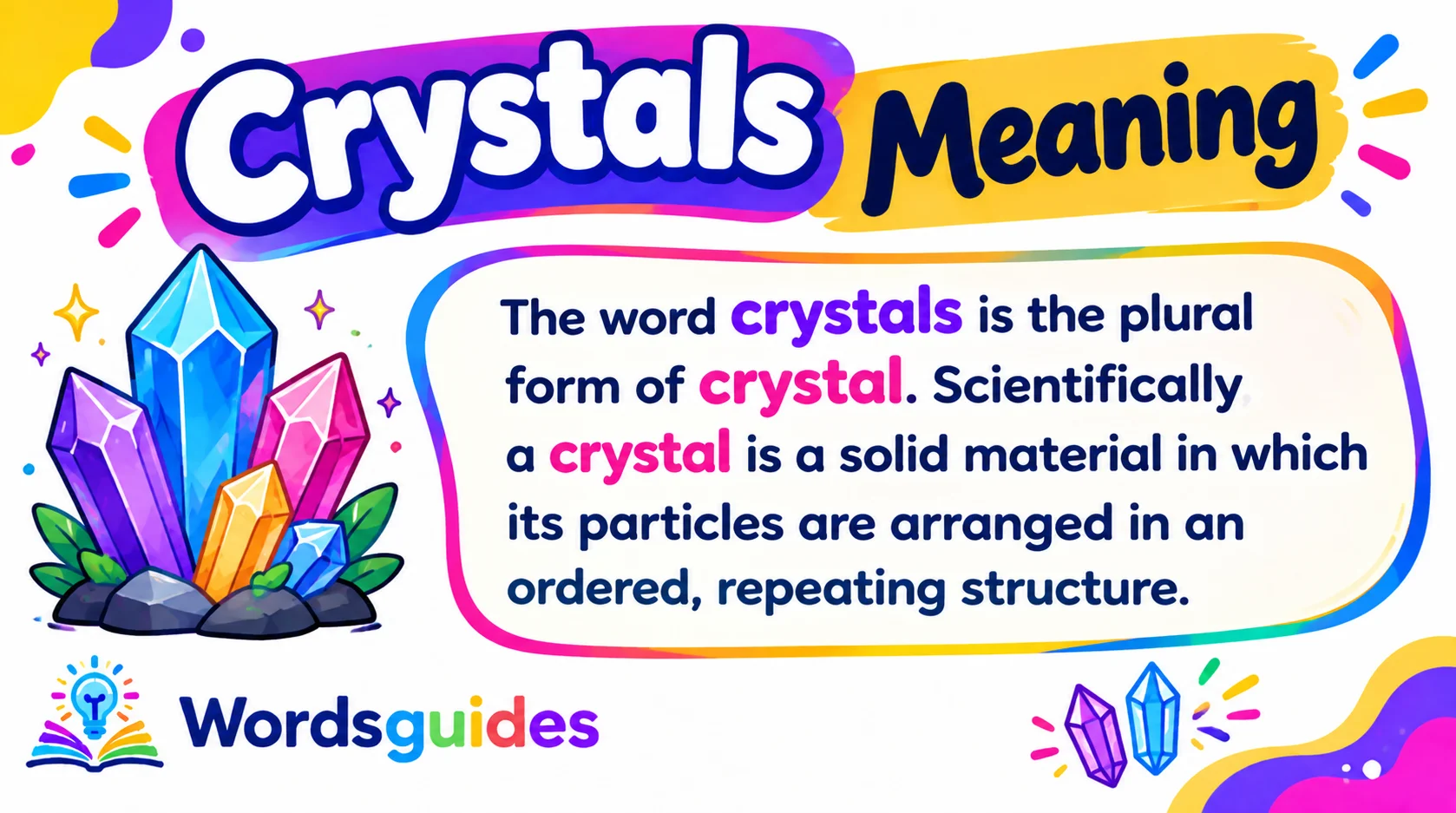
The word crystals is the plural form of crystal. Scientifically, a crystal is a solid material in which its particles are arranged in an ordered, repeating structure.
Crystals can occur naturally or be produced artificially. Common examples include quartz, salt, sugar, and many minerals used in jewelry.
Simple definition
A crystal is a solid with a regular internal arrangement of atoms, ions, or molecules.
In everyday language, however, people often use “crystal” more broadly for attractive mineral specimens or gemstones.
How do you pronounce crystals?
Crystals is pronounced approximately:
KRIS-tuhlz
The singular word is crystal, while the plural is crystals.
What does crystals mean in everyday conversation?
The meaning depends on context. Someone discussing geology may mean mineral structures, while someone discussing jewelry may simply mean decorative stones.
For example:
Mia: What are those crystals on your desk?
Sam: They’re amethyst and clear quartz. I like how they look.
Here, “crystals” refers to physical mineral specimens.
Origin and Background of the Word Crystal
The word crystal has a long history connected with the idea of clear, solid mineral material. It comes through Latin crystallus and Greek krystallos, a word associated with ice and crystal-like substances.
Over time, the meaning expanded beyond transparent minerals. Today, “crystal” is an important scientific term in mineralogy, chemistry, physics, and materials science.
The word also developed broader cultural meanings. In modern wellness and spiritual communities, different crystals are often associated with qualities such as calmness, love, protection, or clarity. These associations are matters of belief and tradition rather than established scientific effects.
How Crystals Are Used in Everyday Conversations
People mention crystals in many different situations. The surrounding words usually make the intended meaning clear.
Talking about jewelry
Ava: Your necklace is beautiful.
Lily: Thanks! It has a small quartz crystal in it.
Here, the crystal refers to a physical stone used as part of jewelry.
Talking about decoration
Ben: What should I put on the shelf?
Chris: Maybe those purple crystals you bought.
The speaker is probably referring to decorative mineral specimens.
Talking about spirituality
Nora: Why did you choose rose quartz?
Emma: I like the symbolism people associate with it.
In this context, “crystals” may refer to stones used in spiritual or personal practices.
Talking about science
Student: Why does salt form crystals?
Teacher: Its particles arrange themselves into a repeating structure as the solution dries.
Here, the term has a scientific meaning rather than a spiritual one.
What Does Crystals Mean on Different Platforms?
The word crystals generally keeps the same basic meaning across social platforms. What changes is the context in which people use it.
On WhatsApp, someone might mention crystals while discussing jewelry, collecting stones, gifts, meditation, or personal interests.
“I found some beautiful crystals at the market today.”
Snapchat
Snapchat posts or messages may use “crystals” when showing jewelry, room decorations, collections, or personal purchases.
Instagram frequently uses the word in posts about gemstones, jewelry, mineral collections, decoration, and spiritual practices. The exact meaning should be inferred from the image and caption.
TikTok
TikTok content can use “crystals” in educational videos about minerals as well as videos discussing spiritual practices or symbolic meanings.
On Facebook, the word may appear in groups or posts about collecting, jewelry, geology, crafts, or spiritual interests.
Discord
On Discord, meaning depends heavily on the community. A geology server may be discussing actual mineral specimens, while another community may use the word in a completely different hobby-related context.
Dating apps
“Crystals” may appear in a dating profile as an interest or hobby. For example:
“Into hiking, crystals, and live music.”
This does not have a special romantic meaning by itself. It simply tells you something the person enjoys or identifies with.
What Does Crystals Mean From a Girl or Guy?
The word crystals does not have a different dictionary meaning when a girl or guy uses it. Gender alone does not determine what the person means.
Context is much more useful. Look at the surrounding conversation, punctuation, emojis, photos, and the relationship between the people talking.
For example:
“Look at these crystals 😍”
could simply show excitement about attractive stones.
Meanwhile:
“I bought crystals for my meditation.”
suggests a personal or spiritual practice.
If someone uses “crystals” in a dating conversation, it still does not automatically have a romantic or sexual meaning. Ask about the person’s specific interest if the context is unclear.
Other Possible Meanings of Crystals
“Crystals” has several genuine meanings depending on the subject.
| Meaning | Context | Example |
|---|---|---|
| Ordered solid structures | Science | “Sugar forms crystals.” |
| Mineral specimens | Geology and collecting | “He collects quartz crystals.” |
| Gemstones | Jewelry | “The ring has small crystals.” |
| Decorative stones | Home decoration | “She placed crystals on the shelf.” |
| Spiritually symbolic stones | Spiritual or wellness practices | “She keeps crystals during meditation.” |
| Crystal-like substances | Chemistry or materials | “The compound produced crystals.” |
The scientific meaning is the most precise, while everyday use often refers to minerals, gemstones, or decorative stones.
Common Crystal Types and Their Associations
Different crystals are commonly associated with different names and symbolic ideas. These associations can vary between traditions and should not be confused with scientifically proven effects.
| Crystal | Common association or description |
|---|---|
| Clear quartz | Clarity, focus, or general-purpose symbolism |
| Amethyst | Calmness, spirituality, or meditation |
| Rose quartz | Love, compassion, and relationships |
| Citrine | Positivity, abundance, or optimism |
| Black tourmaline | Protection in some spiritual traditions |
| Selenite | Cleansing or peaceful symbolism |
| Tiger’s eye | Confidence, courage, or grounding |
| Obsidian | Protection or grounding in some traditions |
These are cultural or spiritual associations, not established medical effects.
How to Respond to Crystals
Your response should depend on what the person means.
If they are showing you crystals
“Those look beautiful! What kind are they?”
If they are talking about collecting
“Nice! How long have you been collecting them?”
If they mention spiritual practices
“Interesting. What do those crystals mean to you?”
If you are curious
“I’ve heard different things about crystals. What do you use yours for?”
If you want a funny response
“At this point, your crystal collection has its own apartment.”
If someone gives you one
“Thank you! That’s really thoughtful. Which crystal is it?”
The safest approach is to ask a simple question rather than assuming why the person values a particular crystal.
Similar Terms and Their Differences
| Term | Meaning | Key Difference |
|---|---|---|
| Gemstone | Precious or semiprecious stone used for decoration or jewelry | Focuses on value, beauty, or jewelry |
| Mineral | Naturally occurring inorganic substance with defined composition and structure | Broader scientific category |
| Rock | Natural solid mixture or mass of minerals or other materials | May contain several minerals |
| Quartz | A specific mineral made of silicon and oxygen | One particular type of mineral |
| Crystal | Material with an ordered internal structure | Describes a structural property |
A crystal and a gemstone are not automatically the same thing. Some gemstones have crystalline structures, but “crystal” is a scientific structural term with a broader meaning.
Common Misunderstandings About Crystals
One common mistake is assuming that every crystal is a gemstone. In science, many substances can form crystals, including ordinary materials such as salt and sugar.
Another misunderstanding comes from spiritual descriptions. Statements such as “this crystal promotes healing” may describe a belief or traditional practice rather than a scientifically demonstrated medical effect.
The word can also be confused with crystal-clear, where “crystal” is being used metaphorically to mean extremely clear or easy to understand.
For example:
“Her explanation was crystal clear.”
Here, “crystal” does not refer to a physical stone.
Is Crystals Appropriate or Safe to Use?
Yes. Crystals is a normal and widely understood word. It is appropriate in casual conversation, education, geology, jewelry discussions, social media posts, and many professional contexts.
The word itself is not rude, offensive, or inappropriate.
However, be careful when discussing claims about crystals and health. Some people use crystals as part of personal or spiritual practices, but crystals should not be presented as a replacement for professional medical diagnosis or treatment.
If someone says they are using crystals for relaxation, meditation, decoration, or personal symbolism, you can discuss that practice without assuming that it has medically proven effects.
Examples of Crystals in Text
- “I bought some new crystals for my collection.”
- “These crystals look amazing under natural light.”
- “Do you know what kind of crystal this is?”
- “My sister gave me a rose quartz crystal for my birthday.”
- “I keep a few crystals on my desk because I like the way they look.”
- “We learned about crystal structures in chemistry today.”
- “Are those real crystals or decorations?”
- “She has a whole shelf filled with beautiful crystals.”
- “I’m interested in geology, so I started collecting mineral crystals.”
- “What do you know about amethyst crystals?”
- “I saw a video explaining how crystals form inside rocks.”
- “Your crystal necklace is really pretty!”
Frequently Asked Questions
What is the simple meaning of crystals?
Crystals are solid materials with particles arranged in an organized, repeating pattern. In everyday conversation, the word often refers to attractive mineral specimens, gemstones, or stones used for jewelry and decoration. In spiritual settings, crystals can also refer to stones associated with particular symbolic meanings or personal practices.
What do crystals symbolize?
Symbolism varies by culture, tradition, and personal belief. For example, rose quartz is commonly associated with love, while amethyst is often linked with calmness or spirituality. These associations are not universal rules, and they should not be confused with scientifically established properties or medical benefits.
Is crystal the same as a gemstone?
Not exactly. A crystal describes a material with an ordered internal structure, while a gemstone is a stone valued for use in jewelry or decoration. Some gemstones are crystalline minerals, but not every crystal is considered a gemstone. Quartz is a good example of a mineral that can occur as crystals and can also be used as a gemstone.
What does crystal mean in science?
In science, a crystal is a solid whose atoms, ions, or molecules have an ordered arrangement that repeats through the material. This structure can produce recognizable geometric forms and influences physical properties. Crystals are studied in fields such as mineralogy, chemistry, physics, and materials science.
What does it mean when someone says they like crystals?
Usually, it means the person has an interest in mineral specimens, gemstones, jewelry, collecting, decoration, or spiritual practices. The exact meaning depends on the conversation. If someone mentions crystals in a profile or casual chat, it is better to ask what they enjoy about them rather than assuming a particular belief.
Do crystals have proven healing powers?
There is no scientific basis for treating crystals as substitutes for medical care. People may use crystals as part of meditation, relaxation, cultural traditions, or personal spirituality, but claims about curing diseases or replacing medical treatment should not be treated as established medical facts.
Conclusion
The meaning of crystals depends strongly on context. Scientifically, crystals are solids with an organized internal structure.
In everyday conversations, the word often refers to minerals, gemstones, jewelry, collections, or decorative stones.
Some people also connect particular crystals with spiritual or symbolic meanings, but those associations vary and are not the same as scientific evidence.
When you see “crystals” in a message, social media post, or profile, check the surrounding words and images to understand the intended meaning. If it is still unclear, asking the person what they mean is the simplest response.

I am Lily Anderson, an English language writer passionate about explaining word meanings, vocabulary, grammar, pronunciation, and language usage through clear, accurate, and easy-to-understand educational content for learners worldwide.